You're logged in with MyAlex  |  Logout

City of Alexandria, VA

Search results cleared

Include archived pages
Most of the content here is written in English. Translate your search to find more content? Translating "" to English... Searching for English phrase ""
  • Live
  • Play
  • Services
  • Business
  • Government
  • Projects & Plans
  • Calendar
  • I want to…

FY 24 Budget Q&A #066: Can you provide a refresh of Budget Question 22 from FY 2023?  Can you please provide a detailing of the number of children served across the Early Childhood Program Area?

Page updated on October 28, 2024 at 10:24 AM

Share

Bluesky Share on Facebook Share on X Share via Email
Translate icon
Translate icon
XWARNING: You have chosen to translate this page using an automated translation system. This translation has not been reviewed by the City of Alexandria and may contain errors.

Question: Can you please provide a detailing of the number of children served across the Early Childhood Program Area, the cost breakdown of each service area, and estimates of the current waiting lists for service in each area (quantity and duration)? Please include the financial impact of plausible service expansions in this area, including the availability of State or Federal dollars. (Mayor Wilson)

Response: 

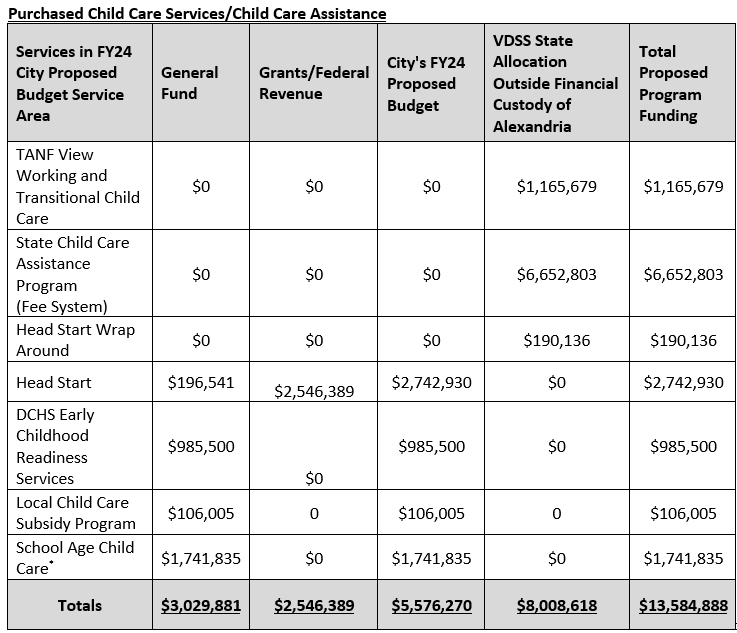
The Early Childhood Program is allocated $9.7 million in the City's FY24 Proposed Budget. Out of this total, $6.4 million is budgeted for non-personnel across Early Childhood programs; $5.6 million of which is allocated for the purchase of childcare services. $3.3 million is budgeted for personnel costs for the 29.34 FTEs who work on early childhood issues.

The 29.34 FTEs in the Early Childhood Program provide a continuum of services for individuals and families, that include: providing case management for individuals with developmental disorders; enrolling and providing case management services for children in child care services; regulating family child care homes; facilitating the professional development of early childhood providers; delivering early developmental intervention services; and implementing early childhood mental health prevention, early intervention, and treatment services.

Additionally, the Early Childhood Program receives a State Budget Allocation of $8.0 million for child care assistance (TANF, Transitional Child Care and the Fee System). This funding is expended at the State level for childcare vendors in the City while services are managed locally, and therefore $8.0 million is not reflected in the City budget. The total funding available for childcare assistance/purchased services is $17.7 million for FY24.

FY 24 BM 066 Table 1.PNG

*School Age Child Care: Represents the Department’s agreement with The Campagna Center and includes $22,731 for program monitoring and scholarships.

Temporary Assistance for Needy Families (TANF) and Transitional Child Care

FY24 Budget: $1,165,679

Average number of Children served per month FY23: 59

Number of Children on Waiting List: 0

Temporary Assistance for Needy Families (TANF) and Transitional Child Care consists of Federal and State funds. These are mandated programs, so funds are made available by the State as they are needed; therefore, these programs have no wait lists. Participants may be provided with services such as job skills training, work experience, job readiness training, child care assistance, transportation, and other work-related expenses.

The FY23 Monthly TANF Child Care target is 80 and 71 children are being served.   The decrease continued throughout the pandemic when VIEW activities were offered virtually, and TANF participation was no longer mandatory; decreasing the requests for childcare.

State Child Care Assistance (Subsidy) Program

FY24 State Budget: $6,652,803

Average number of Children served per month FY23: 409

Number of Children on Waiting List: None

The Child Care Subsidy Program is supported through State funds. The approved state target for children to be served in Alexandria will increase from 419 (FY23) to 532 (FY24) based on the increased number of children served in FY23.  The program processed 291 family applications in FY22 of which 209 were approved. The program processed 319 family applications in FY23 of which 120 were approved. With a few exceptions, applications were processed within 30 calendar days under normal workload conditions.

Financial Impact of Plausible Service Expansions:

Approved policy exceptions and waivers put in place during COVID resulted in the removal of identified barriers for providers through incentive grants, removal of the child absence penalty and reimbursement rate increases for level 1 providers. At the state level, substantive barriers for families were removed to include raised income level threshold, approval of work search as an allowable activity to receive child care, an automatic 12-month eligibility renewal for services, and elimination of the parent co-payment. With the exception of the elimination of the parent co-payments, these temporary exceptions became permanent in FY23.  Parent co-payments resumed January 1, 2021.  During the first year of the COVID-19 pandemic, Alexandria saw an unprecedented increase (almost 50%) in the number of applications for child care assistance, with more than half meeting eligibility (up from 30%).

Head Start Wrap-Around

FY24 State Budget: $190,136

Approved Child Target: 19

Average number of Children served per month FY22: 13

Head Start Wrap-Around funds are 100% Federal and are made available as needed by the State to provide before- and after-school services to Head Start children who need care beyond the 6-hour Head Start program day.

Alexandria Head Start

FY24 budget: $2,742,930              

Average number of Children served per month FY23: 210

Number of Children on Waiting List: 83 due to an inability to open 5 classrooms because of a shortage of teachers and the Office of Head Start no longer allowing a virtual service option.

Number of Children with pending enrollment: 10

The Alexandria Head Start (AHS) program is funded for 309 children of families who have income at or below 100 percent of the Federal Poverty Level (FPL). The number of children allowed to be enrolled is determined by U.S. Department of Health & Human Services Head Start Office. Full enrollment was not realized at any time during the pandemic. Enrollment efforts are on-going with the goal to reach capacity. Families who have children on the Alexandria Head Start waitlist were approved in March 2023 to be offered enrollment in Family Day Homes with costs to be paid using ARPA hardship funds. The majority of AHS funds are supported by the Federal Head Start program with a portion provided by the City’s General Fund.

DCHS Early Childhood Readiness Services

FY24 Budget: $985,500

Average number of Children served per month FY23: 332

Number of Children on Waiting List: 0

Early Childhood Readiness is supported 100% through the City’s General Fund for early childhood education services that support expanded summer learning and extended hours for children ages 3-to-5 during the school year for Alexandria’s VPI, Head Start, and other students who meet learning risk factors. Funding administration is based on alignment with service priorities, establishment of a sustainable process for awarding funds, and invites capacity building and partnership innovation through a mixed delivery system that leads to closing the gap of unmet needs.

Local Child Care Subsidy Fee System

FY24 Budget: $106,005

Average number of Children served per month FY23: 0

Number of Children on Waiting List: 0

This program area is supported 100% through the City’s General Fund to serve as a bridge for families who have significant child care needs that cannot be met though other resources. The per child funding amount for local subsidy follows the state subsidy rates which are determined based on the age of the child, program type, any special needs of the child, and attendance frequency. The number of children served can fluctuate based on these patterns of children enrolled. In order to leverage our maximum drawdown of state subsidy dollars, children are moved from local subsidy funding whenever other options for funding become available. This allows greater flexibility for meeting the needs of a wider pool of low-income families.

School Age Child Care

FY24 Budget: $1,741,835

FY 24 BM 066 Table 2.PNG

This program is operated by the Campagna Center. Out of school time programs were significantly impacted by the Covid-19 pandemic. Enrollment numbers continued to increase as schools reopened and are reaching pre-pandemic numbers. This program area is supported through the City’s General Fund.  Waitlists exists due to space needs and staffing shortages.

Direct Services Provided by DCHS Clinical Staff
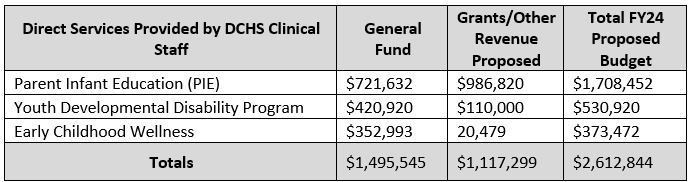
FY 24 BM 066 Table 3.PNG

Early Intervention/ Youth Intellectual Developmental Disability and Early Childhood Wellness (Infant and Early Childhood Mental Health Services)

FY24 Budget: $2,612,844

Individuals Served /Services Provided FY23: 645

These programs provide early intervention, assessment, case management and treatment services for children 0-21 years of age. The services are provided through three specialized units: Part C Early Intervention, Developmental Disabilities Case Management, and Early Childhood Wellness/ Providers Support Services.

The Parent-Infant Education (PIE) Program (Part C Early Intervention)

Number of Children on Waiting List: None Allowed (All eligible children must be served within 45 calendar days) (Per Federal I.D.E.A law)

The implementation and funding of Early Intervention Part C services is a shared responsibility of the Commonwealth and local jurisdictions. The Department of Behavioral Health and Developmental Services (DBHDS) has been designated as the Lead Agency for Part C in Virginia. The Code of Virginia, §§2.2-2264 and 2.2-5300 through 2.2-5308, provides the framework for the Infant & Toddler Connection of Virginia Part C system. Continued State Funding of Part C is critical to ensure all eligible children and families receive timely and appropriate early intervention supports and services. In recognition of continued growth and funding shortfalls, annual increases have been allocated since FY 2015 and the General Assembly increases of $2.5 million and $3.8 million were approved for FY21 and FY22, respectively. Overall, impacts of flexibilities, such as telehealth, allowed during the COVID-19 pandemic likely prevented more significant budget shortfalls and lessened the impacts of provider shortages.

The Alexandria Early Intervention Part C Parent Infant Education (PIE) Program provides assessment, case management and developmental therapy services for children birth to age 3 years utilizing evidence-based practices within the child’s natural environment settings. Services were provided to the 365 children who were eligible in FY22. Based on current staffing levels this resulted in monthly caseload sizes of 55 children per staff member. This is a 35% decrease from the previous year due the addition of 2 additional staff following a review of the needed staff and costs in FY22.

1 FTE senior therapist position is included in the proposed FY24 budget. This position will support the delivery of individualized infant and early childhood mental health supports to children identified as having delays in social/emotional domains of development. Since July 2021, the PIE Program screened 563 infants and toddlers with 47% of these children scoring above the cutoff range on the ASQ-SE; indicating further need for assessment with a clinician was warranted.

Youth Intellectual and Developmental Disabilities Program

Number of Children on Waiver Wait List: 82

The Youth Developmental Disabilities Program provides intake, assessment, monitoring and support coordination services to individuals ages 3- 21 years of age. The staff in this program served 108 individuals in FY22. 26 children and youth were enrolled in active case management and 82 individuals received on-going support and monitoring pending availability of a Medicaid Waiver slot.  Medicaid waiver slots are assigned to localities annually. The number of slots a locality receives is based proportionally on the number of individuals on the waitlist. There are 44 individuals who need to be assessed for eligibility to be placed on the waiting list. Scheduling of these intake assessments are pending due to insufficient staffing capacity. The funding structure for this program is 0.5 Program Manager (vacant), 3.0 FTE Support Coordinators (1 is a new FTE in the FY24 proposed budget) and a 0.5 FTE Intake Coordinator (vacant). It has been challenging to fill the 0.5 Intake Coordinator position. Priority utilization of the new fulltime FTE will be to schedule the 44 intake requests in addition to ensuring that individuals currently on the waiver waitlist have completed clinical reviews needed for their prioritization upon the release of new waiver slots to Alexandria in the summer. 

Early Childhood Wellness and Provider Development

Numbers Served:  172 center-based and Family Child Care classrooms

Number of Children on Waiting List: None

The purpose of this program is to improve outcomes for children, from birth up to 6 years of age, by developing, maintaining, or enhancing infant and early childhood mental health promotion, intervention, and treatment services. The program services are designed to promote positive social skill development and reduce behaviors that do not support classroom success through implementation of an Infant Early Childhood Mental Health (IECHMH) consultation model with the goal of developing a more sustainable approach to providing multigenerational services that strengthen positive adult-child relationships in the home and in the classroom, given the limited capacity to respond to increased unmet needs of children presenting with social emotional developmental concerns. The approach is two-fold: 1) Implementation of the Classroom Assessment Scoring System® (CLASS) to provide support and consultation primarily to teachers and administrators to enhance their capacity to boost student learning and development and 2) fill service gaps for evidence-based mental health promotion, prevention, early intervention, and treatment by leveraging a tiered public health framework into which care-givers, professionals, and systems can assess, align and implement evidenced based strategies and practices through resources of the DCHS Parent Infant Education (PIE) Program, the ACPS Child Find Program and evidenced based whole community public health strategies (universal developmental screening using the ASQ® and ASQ-SE® and The Basics Insights™) that build parent capacity to support their child’s social/emotional development. This team supports 172 preschool classrooms through consultation and observation.

Virginia Preschool Initiative (VPI) Budget Managed by Alexandria City Public Schools

Number of Children Enrolled FY2023: 351

FY2023 Budget: $1,541,613 (Local Match of $4,494.50) 

Alexandria City Public Schools (ACPS) has oversight and receives state and local funds for VPI in the ACPS budget. To obtain state funding, the locality must ensure the provision of a quality preschool education, health services, family engagement, facilitation of comprehensive services and a plan for transportation. In FY23, 192 children are being served in twelve ACPS classrooms and 159 children are served in four community-based child care centers.  As the City is allocated 567 VPI slots by the state, this means that the city currently fills 55.5% of its VPI allocated full-time VPI slots.

Printable Verison

Contact Us
Alex311 | 703.746.4311
Follow Us
  • BlueSky
  • Facebook
  • X
  • YouTube
Visitor Information

VisitAlexandriaVA.com

  • Jobs
  • Payments
  • Departments
  • Newsroom
  • Social Media
  • Emergency Hotlines
  • Accessibility
  • FOIA Requests
  • Privacy & Legal

Alexandria City Hall
301 King Street
Alexandria, VA 22314

City of Alexandria Seal
© 1995–2023 City of Alexandria, VA and others.
Hold on, redirecting...