

Question: Provide an overview of the use of borrowing for Affordable Housing projects. What would this look like in terms of size, timing, and the opportunities it would open for investment in Affordable Housing. (Mayor Gaskins)
Response:
The City’s commitment of funds to affordable housing is currently limited by the cash-based nature of sources dedicated to affordable housing. Cash funds must accumulate to sufficient levels to support a given affordable housing project. The use of borrowing is one tool available to accelerate or advance projects that are ready to proceed when City funding becomes available. The City has used this tool in a limited fashion, with the last Housing-specific issuance occurring in 2017, totaling $4.4 million to support The Spire project (2280 North Beauregard Street). Principal and interest payments (debt service) for this issuance are paid for from the 1-cent real estate tax dedication for Affordable Housing.
Immediate Term Investments
The City’s Office of Housing has identified three projects that are currently ready to proceed but are awaiting City funding to become available. The City funding need for these three projects total $7.0 million. This identified need is above and beyond the $11.6 million in planned funding for FY 2027, which is already committed to other projects, including the underway Sanse and Naja project.
Longer-Term Strategy / Identification of Projects
Current estimates suggest that more than $100 million will be required to address the existing affordable housing pipeline. This estimate does not account for additional mission-driven projects or preservation opportunities that may not be moving forward due to unavailability of local funding to support projects.
The City is currently in the process of updating the Housing Master Plan (“Housing 2040”). Finalization and adoption of the new master plan will inform strategies for implementing recommendations from the plan, including advancing projects in the pipeline. This work will include efforts to outline and develop the full array of tools available to the City to advance affordable housing projects and defining the parameters that make a project suitable for each tool; this will include the potential use of borrowing.
City’s Debt Management Policies and Timing of Borrowing for Housing
The City’s self-adopted debt management policies were last updated as part of the FY 2018 budget process and are as follows:
- Debt as a Percentage of Fair Market Real Property Value (Ceiling: 2.50%)
- Debt Service as a Percentage of General Government Expenditures (Ceiling: 12.00%)
- 10-Year Debt Payout Ratio (Floor: 50.00%; Target: 65.00%)
Current exclusions from the debt management ratios include debt serviced by the Sanitary Sewer Maintenance Fee, the Stormwater Utility Fee, and the Potomac Yard Special Tax District. Debt serviced by these three sources are excluded from the debt as a percentage of fair market real property value and debt service as a percentage of general government expenditures management ratios as they are not reliant on the general tax base and are considered “double-barrelled”, meaning that if the specific non-general fund revenue sources were unable to service the debt, the City’s general taxing authority (general fund) would serve as the back-up source of payment.
Although there are revenue dedications for Affordable Housing (the 1-cent of the real estate property tax and 1% of the restaurant meals tax) that would service borrowing, both of these dedications are ultimately part of general fund revenues. As such, any contemplated new borrowing for housing-related projects would be applicable to the City’s adopted debt management ratios, just as existing housing-related debt is included in the ratios. Like any other new City or School capital project being considered, the decision to pursue additional borrowing to support affordable housing projects would require prioritization along with currently planned projects and funding amounts to ensure the City maintains a manageable debt load.
The City is currently projected to be very close (within 0.25 percentage points of the ceiling set by City Council) to its debt limit in FY 2031 - FY 2033. It is important to note that the larger amounts of debt capacity remaining in FY 2027 – FY 2030 are a result of cash flow planning of already approved projects; adding material amounts of debt in that time period exacerbates the debt capacity concerns for FY 2031 – FY 2033.
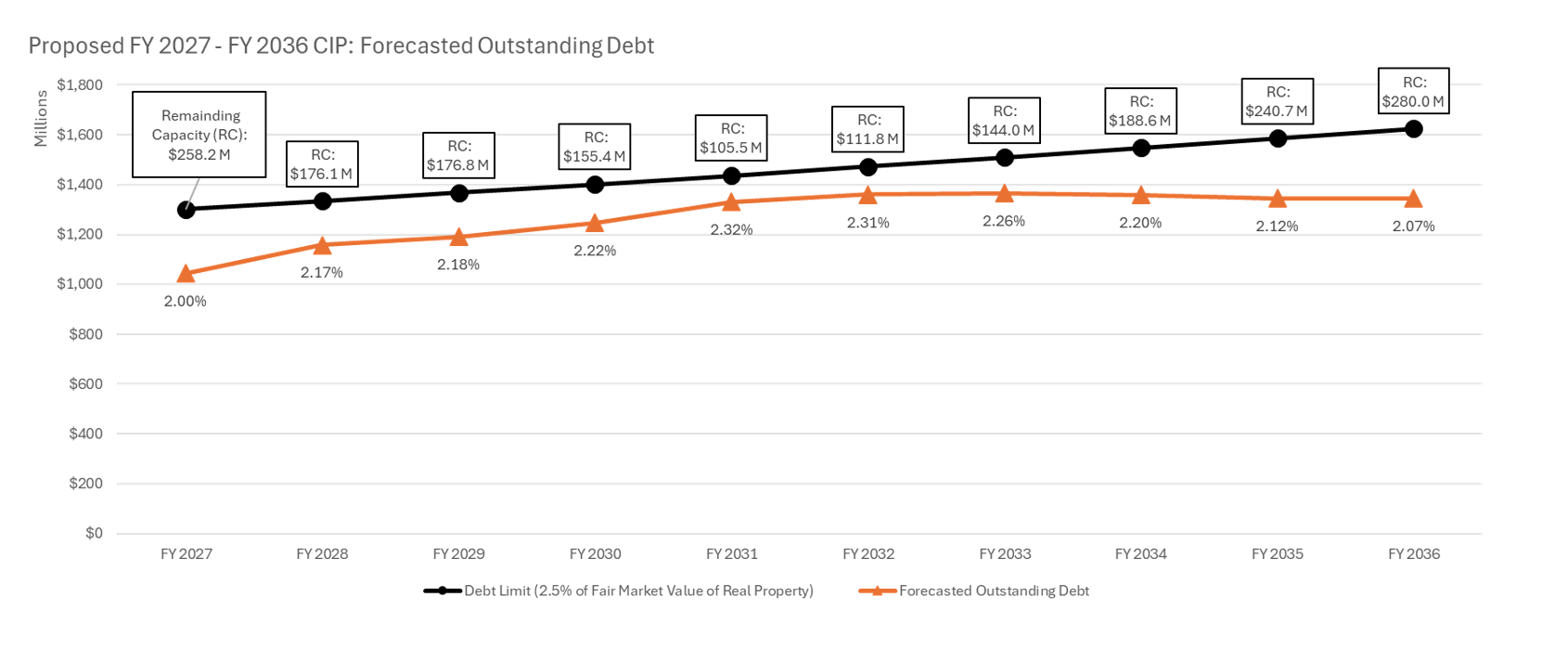
Considering this, larger-sized issuances for housing should not be programmed into the CIP until FY 2034 or later.
If nearer-term borrowing were to be considered to support affordable housing projects, without identifying offsetting reductions or deferrals of other planned City and School projects, staff would recommend limiting the issuance size to no more than $2 million and for this to be scheduled in the FY 2028 – FY 2029 timeframe.
Impact of Additional Borrowing on Dedicated Affordable Housing Sources
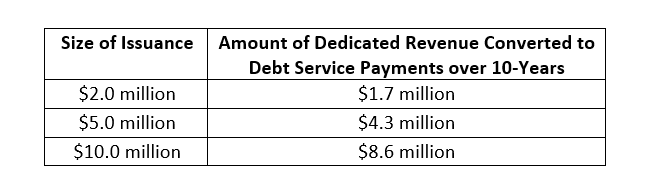
New borrowing for affordable housing would result in additional principal and interest payments to service the debt. This debt service would be paid out of the revenue dedications for affordable housing, and decrease cash available for projects. The chart below provides examples of issuance sizes and the amount of dedicated revenue that would need to be converted from cash capital for projects to debt service payments, over the 10 years following the issuance.
Printable Version