
Project Summary
Current Phase: Planning
Locations:
Sponsoring Division: Sanitary Infrastructure
Managing Division: Project Implementation
Project Description
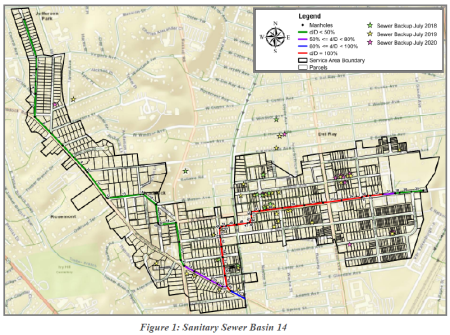
This project focuses on evaluating the sanitary sewer system capacity in Basin 14, where repeated sewer backups have occurred in recent years. The City’s 2017 hydraulic model indicates that some pipes may be undersized; however, the model is incomplete and does not reflect all infrastructure or recent improvements, such as manhole insert installation and recently completed pipe lining using cured-in-place pipe technology.
The City of Alexandria has tasked an engineering consultant to review existing data, collect additional field data (including survey data), and conduct flow monitoring to update and expand the hydraulic model. The revised model will be used to assess system performance under various storm scenarios and to develop recommendations aimed at reducing sewer backups and improving overall system reliability.
Project Funding
Total Budget: $4.9M
Planning: $0.44M
Design: $0.49M
Construction: $3.96M
Funding Breakdown
This project is funded using Sanitary Sewer enterprise Fund Revenues and is programmed in the City’s Capital Improvement Program.
Schedule
Planning: Spring 2026 - Summer 2027
Design: Summer 2027 - Winter 2029
Construction: Winter 2029 - Summer 2030
Planning Phase
Planning Overview
This project is in the planning phase to evaluate the sanitary sewer system in Basin 14 due to repeated sewer backups. The planning effort includes review of existing data, collection of field data, flow monitoring, and updates to the hydraulic model to evaluate system performance under various scenarios. The project will include model calibration, capacity assessments, and evaluation of improvement alternatives to develop recommendations for reducing sewer backups and improving system reliability. Deliverables include flow monitoring reports, calibration and capacity assessment reports, and an alternatives analysis report.
Planning Public Outreach
Residents were actively involved through interviews, providing valuable information on sewage backup and flooding events. Their input influenced the study's recommendations and conceptual design.