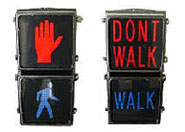

Traffic signals are installed at intersections to create gaps in the traffic flow of a street, allowing pedestrians to cross safely. The City of Alexandria manages nearly 250 signalized intersections and all but a handful have either pedestrian signals, pushbuttons, countdown timers or audible pedestrian signals.
Still, the City recognizes that it can improve pedestrian safety at many intersections with a combination of signalization, striping and pedestrian enhancements. We are in the process of adding new pedestrian countdown timers and audible signals where appropriate. The information below is intended to help shed some light on one aspect of intersection crossings: pedestrian signals.
Traffic Signals
Traffic signals – those mounted on mast arms, on poles or the hanging variety – facilitate traffic flow but are also crucially important to pedestrians. Signals allow adequate crossing time for pedestrians and are particularly important at high-use, mid-block crossings on high-speed roads, multi-lane roads or at highly-congested intersections.
In areas such as Old Town, on Mount Vernon Avenue in Arlandria or along some sections of Duke Street, signals may be closely spaced – sometimes every block. This is important because high pedestrian traffic exists during a majority of the day. In these situations, the City of Alexandria uses fixed-time signals to consistently allow pedestrian crossing opportunities.
Pedestrian "cycles" (the amount of time dedicated to a pedestrian crossing during different phases of a traffic signal) are generally timed based upon a maximum walking speed of 3.5 ft per second. In areas with a heavy concentration of children or older adults, a lower speed of less than 3.5 feet per second may be used to determine pedestrian clearance time.
Pedestrian Signals
Most people have used a pedestrian signal at one point or another. These signals – the traditional WALK/DON'T WALK signs or those with solid walking persons – are important at many intersections – especially when vehicle signals are not visible to pedestrians or when signal timing is complicated (i.e. where there is a dedicated left-turn signal for motorists, or when exclusive pedestrian intervals are provided).
The simplest form of pedestrian signal includes three types of indicators:
- The international symbol for pedestrians (a solid walking person) or steady WALK sign implies it is OK to cross and watch for vehicles
- A flashing hand or flashing DON'T WALK sign implies don't start crossing or finish crossing if started
- A steady hand or steady DON'T WALK sign implies don't cross or stay out of the crosswalk
Pedestrian Pushbuttton Signals 101 – Why They're Not Well Understood
Pedestrian pushbutton signals are installed across Alexandria at intersections on main roads or with high volumes of pedestrians.
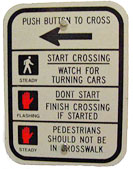
Pushbuttons allow pedestrians to call a walk signal. However, the way pedestrian signals work is not well understood. (A 2004 article in the New York Times fanned the flames for many cynical pedestrians when it concluded that many pedestrian pushbuttons in the Big Apple do not work and essentially function as mechanical placebos. Many of the pedestrian pushbuttons in Alexandria are operationally different, though.)
By pushing a pedestrian button, you are notifying the computerized signal controller at the intersection that you are waiting to cross. Although many people assume this always shortens the green light for motorists and hastens the pedestrian cycle, in fact it does not always do this. In some cases, the pedestrian pushbutton works to ensure that a full "walk" phase will take place at the end of the usual green traffic phase, thus allowing a pedestrian sufficient time to cross the street.
At some lights, the pushbutton shortens the green light for motorists and allows pedestrians to cross sooner. The City has also implemented some Leading Pedestrian Intervals (LPIs). An LPI gives pedestrians an advance walk signal before motorists get a green light, giving the pedestrian several seconds to start in the crosswalk when there is a concurrent signal. This makes pedestrians more visible to motorists and motorists more likely to yield to them. However, this is not always a good solution for pedestrians with accessibility needs because there is no audible warning of the pedestrian phase.
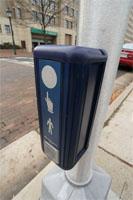
Where pedestrian crossings are particularly challenging for those with accessibility needs, the City of Alexandria also seeks to install accessible pedestrian signals. Alexandria uses a pushbutton-integrated system that has a speaker and vibrating surface or arrow at the pedestrian button. The sound comes from the pedestrian pushbutton housing, rather than the pedestrian head.
A constant quiet locator tone, repeating once per second, provides information to blind individuals about the presence of a pedestrian pushbutton and its location. The locator tone is only intended to be audible 2 to 4 meters (6 to 12 feet) from the pole or from the building line, whichever is less.
The walk interval is indicated by the same tone at a faster repetition rate and by a speech message.
Some of the pushbuttons on Alexandria intersections are larger because they are newer and more easily used by those with accessibility needs. The City is in the process of replacing pushbuttons where appropriate.
If you believe a button is not working properly, please contact Alex 311, either by phone (311 or 703.746.4311) or online.
Countdown Signals
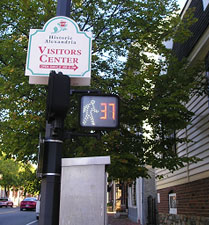
A better solution at many intersections is a pedestrian countdown signal. The signals – like the one pictured here – are installed at intersections where high volumes of pedestrian traffic is expected. The number shown indicates the number of seconds left before the signal changes and traffic will begin crossing again. The hand goes from steady white to red as the time approaches 0.
The City of Alexandria has installed countdown timers at more than 50 intersections around the city and adds approximately five new intersections a year to this total (the countdown timers cost approximately $1,000 each or approximately $5,000 per intersection). This cost is occasionally borne by developers.
School Zone Flashing Signals
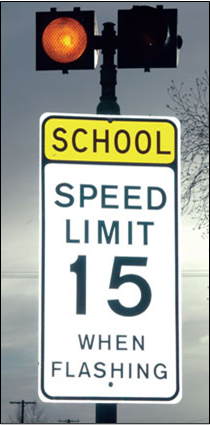
Some school zones may have speed limits as low as 15 mph when signs are flashing. Always drive more carefully near schools, playgrounds, parks, and residential areas because children may suddenly dart into the street. Also, many children have not yet developed the ability to judge speeds and distances well enough to cross streets safely when cars are moving fast.
- Bicyclists and pedestrians.
- School safety patrols or school crossing guards. Be sure to obey their directions. For the crossing guard’s safety, allow him or her to safely get to the side of the road before driving ahead.
- Stopped school buses and children crossing the street. Some school buses flash yellow lights when preparing to stop to let children off the bus. The yellow flashing lights warn you to slow down and prepare to stop. When the bus flashes red lights (located at the top front and back of the bus), you must stop from either direction until the children are safely across the street and the lights stop flashing.
Report an Issue
The City of Alexandria encourages residents to contact us with questions about traffic signals, pedestrian signals that do not seem to be working, or to request new pedestrian signals. Please use Alex311 to report broken pedestrian signals or traffic lights.
Visit the City’s Complete Streets page to learn more about how the City is making streets safer, more efficient, and comfortable for all users.