
Adopted Short-Term Residential Rental (STR) Regulations
Operators and their management companies must familiarize themselves with the adopted Short-Term Rental Ordinance and comply with all applicable City rules and regulations including safety equipment installation, noise and solid waste regulations, and maximum occupancy.
- Adopted Short-Term Residential Rental Ordinance At-a-Glance
- Adopted Short-Term Residential Rental Ordinance (Full Version)
- Good Neighbor Guide: The Guide must be provided to all guests at least 24 hours prior to check-in and displayed in a prominent location at all times (for example, on the fridge or next to the front door).
Key STR Terms
- Short-term residential rental: The provision of a room or space that is suitable or intended for occupancy for dwelling, typically for a period of fewer than 30 consecutive days, in exchange for a charge for the occupancy.
- Operator: A party having a legal interest in any dwelling offered as a short-term residential rental. Operators are the property owners or lease holders of the STR.
- Registered local agent: A party designated by the operator to perform obligations under city law related to a short-term residential rental. Registered local agents are typically referred to as property managers.
- Abutting property: All property that touches the property in question and any property that directly faces (and, in the case of a corner lot, diagonally faces) the property in question.
STR Permit Process and Requirements
City staff are processing permits in small batches, with the process expected to be completed by summer 2026. Until permit processing for all currently operating STRs is complete, we will not have contact information for every STR, making rapid enforcement difficult in many cases. Please be patient as staff work to roll out the new permit program. Operators should become familiar with the application process and requirements before beginning the permit process.
Application Process and Requirements
STRs operating for more than 10 days annually require a Short-Term Residential Rental Permit and must pay an annual non-refundable permit fee of $350 for owner unoccupied rentals or $100 for owner occupied rentals. Below is a step-by-step guide to obtain a STR Permit.
Read the Short-Term Residential Rental Ordinance and its summary. Understand the rules and regulations before beginning the application process. If you have questions related to any of the rules and regulations, please contact staff.
- Good Neighbor Guide: Securely post the guide in a prominent location such as a refrigerator or framed next to the front door.
- Smoke Detectors:
- Minimum of one smoke detector on each habitable level at least 10 ft. from cooking appliances and a minimum of 3 feet for any air register.
- Inside and outside each bedroom.
- If mounted on wall, there must be 4 inches minimum and 12 inches maximum from the ceiling and must be 4 inches from any corner.
- Carbon Monoxide Detectors:
- On each level that has bedrooms, detectors shall be installed within 10 feet of the bedrooms and mounted on ceilings or walls with no height restrictions.
- Fire Extinguishers:
- At least one portable fire extinguisher should be on each floor and within ten (10) feet of the kitchen. It must be visible and not blocked by furniture, behind a door or in a closet.
- Photos of the posted Good Neighbor Guide and required safety equipment.
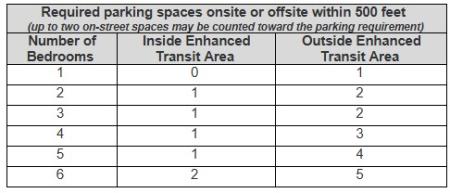
- Maps indicating parking locations and/or parking agreements. Outside the enhanced transit area (ETA), operators are required to provide 0.75 parking spaces per bedroom. Within the enhanced transit area, operators are required to provide 0.25 space per bedroom. Calculations of parking spaces that result in a fractional number of one-half (0.5) or more are rounded up to the next whole number.
- Proof of property ownership or lease.
- Leased (owner-unoccupied) properties require a signed and dated owner’s permission letter with contact details.
- Owner-occupied rental applicants must provide any two of the following to demonstrate proof of residency in the short-term rental:
- Driver's license or DMV ID
- Voter registration ID card
- Bank or credit card statement (financial information may be redacted)
- Official letter from a government agency (social security, courthouse, public benefits office)
- Payroll stub showing name and address (income details may be redacted)
- Personal property tax receipt
- IRS tax forms (W-2 or 1099) (income details may be redacted)
- U.S. or Virginia income tax return (income details may be redacted)
Staff will review your application and required documentation to ensure completeness. If more information is required or there are questions about the property, staff may request more information or schedule an inspection.
Once staff have deemed your application complete, you will send notices to neighboring properties and the owner of the subject property (if different from yourself) via registered/certified mail. The required abutting property notice letter and addresses will be e-mailed to you by staff.
Provide staff with the “Proof of Mailing” receipt from the USPS.
Staff will provide a copy of your permit for you to sign and return. Once you return the signed permit, you may begin operating.
Frequently Asked Questions (FAQs)
- Residential zones: No parties or special events exceeding maximum occupancy are permitted.
- Commercial, Office, Mixed-Use, Industrial zones: Parties and special events which exceed the maximum occupancy are permitted provided operators comply with the following standards:
- Event hours are limited to 9:00 a.m. to 10:00 p.m. Sunday through Thursday, and 9:00 a.m. to 11:00 p.m. Friday and Saturday.
- Loading, unloading, and deliveries for events is prohibited between 11:00 p.m. and 7:00 a.m.
- Food, beverages, and other materials associated with events should not be stored outside.
- Trash should be stored inside or in containers that prevent escaping odors or invasion by animals.
- Litter on the site and on public rights-of-way within 75 feet should be monitored and picked up at the end of each event.
Outside the enhanced transit area (ETA), operators are required to provide 0.75 parking spaces per bedroom. Within the enhanced transit area, operators are required to provide 0.25 spaces per bedroom. Calculations of parking spaces that result in a fractional number of one-half (0.5) or more are rounded up to the next whole number. If no spaces are provided on the STR property, the operator may count up to two on-street parking spaces and/or provide spaces through a parking agreement at a nearby property.
The operator or the local agent is required to be reachable via telephone 24 hours per day, 7 days per week and should be the FIRST point of contact for ANY issue or complaint. The operator or their local agent can typically respond to and resolve issues far faster than City staff.
All abutting properties will receive mailed notice during the permitting process. Mailed notice includes contact information for the operator and registered local agent (if applicable), maximum occupancy, and whether parties/special events are permitted.
If you do not have contact information or contact with the local agent or operator is unsuccessful, please contact the following depending upon the time and nature of the issue.
During business hours (Weekdays - 7 a.m. to 7 p.m.; Saturday - 8 a.m. to 12 p.m.)
- Alex311
- Phone: 311 or 703.746.4311
- Online: alexandriava.gov/Alex311
- STR Hotline (24 hours per day)
- Phone: 703.215.3609
- Online: secure.hostcompliance.com/alexandria-va/complaints
- Alex311
After business hours (Weeknights - 7 p.m. to 7 a.m.; Saturday - 12 a.m. to 8 a.m.; Saturday - 12 p.m. to 12 a.m.; Sunday - All day)
- STR Hotline (24 hours per day )
- Phone: 703.215.3609
- Online: secure.hostcompliance.com/alexandria-va/complaints
- Only violations of noise, maximum occupancy, and unauthorized parties/events will be prioritized for response after business hours
- Police Non-Emergency
- Phone: 703.746.4444
- Noise and on-street parking violations in progress only. Operators are not liable for violations by guests off the property.
- STR Hotline (24 hours per day )
Failure to obtain a permit or comply with City Code or the Zoning Ordinance will result in civil citations, revocation, or denial of a permit. Civil citations differ based on the nature of the violation. Failure to obtain a STR permit will result in an initial $200 citation and a $500 citation every 10 days thereafter until a permit application is submitted.
Background
In 2024, the City Council directed staff to research short-term residential rentals and conduct a community engagement process to draft recommended regulations. On March 15, 2025, City Council adopted the proposed recommendations developed during the process.
‘Home sharing’ (or short-term residential rentals) refers to the rental of houses, condos, or apartments to short-term guests, which has become a popular way for owners to earn extra income across the United States. Short-term residential rentals typically occur through online home-sharing platforms, such as Airbnb, Expedia, FlipKey, HomeAway, TripAdvisor, and VRBO.
In 2017, the Virginia General Assembly adopted a law that allows a locality to adopt an ordinance to establish a local short-term residential rental registry. In 2018, Alexandria established its short-term rental registry which is maintained by the Department of Finance. At the time of the registry adoption, the City Council determined that regulation of short-term rentals should be handled via existing City Code and Zoning Ordinance regulations.
Due to recent calls for additional regulation of short-term rentals, the City Council directed staff to research the topic, provide a report and presentation, and begin a study to include community engagement. Below are the report and presentation shared with City Council in May 2024:
- May 2024 City Council Meeting
- Presentation to City Council (May 28, 2024)
- May/June: Continue research on short-term rental regulations implemented in other jurisdictions.
- August 15-September 15
- Community members were invited to watch an 18-minute video to help understand the background, benefits, and impacts of short-term rentals. The video also presents proposed new policies to address common concerns.
- An online feedback form was open from August 14-September 15 for community comments and questions. Feedback received will help staff better craft policy recommendations.
- September 20: Planning Commission Retreat Update
- October 29 - November 17
- Community members were invited to watch a 14-minute video that shares what the City has heard to date and how input received informed revised proposed regulations.
- An online feedback form was open from October 29 - November 17. Based on comments received, staff may propose additional changes prior to City Council’s consideration of the proposed regulations in February.
- February public hearings on recommendations and proposed text amendment
- Proposed Short-Term Residential Rental Ordinance At-a-Glance
- February 4: Planning Commission
- February 22: City Council
- March 15, 2025 Adoption Public Hearing
- Effective Date of Short-Term Residential Rental Ordinance
- September 1, 2025
- Begin processing short-term rental permits
- Early-December 2025
Contact Information
For additional information on Short-Term Residential Rentals or the permitting process, contact Tierra Johnson, Short-Term Rental Coordinator, tierra.johnson@alexandriava.gov, 703.408.6276.