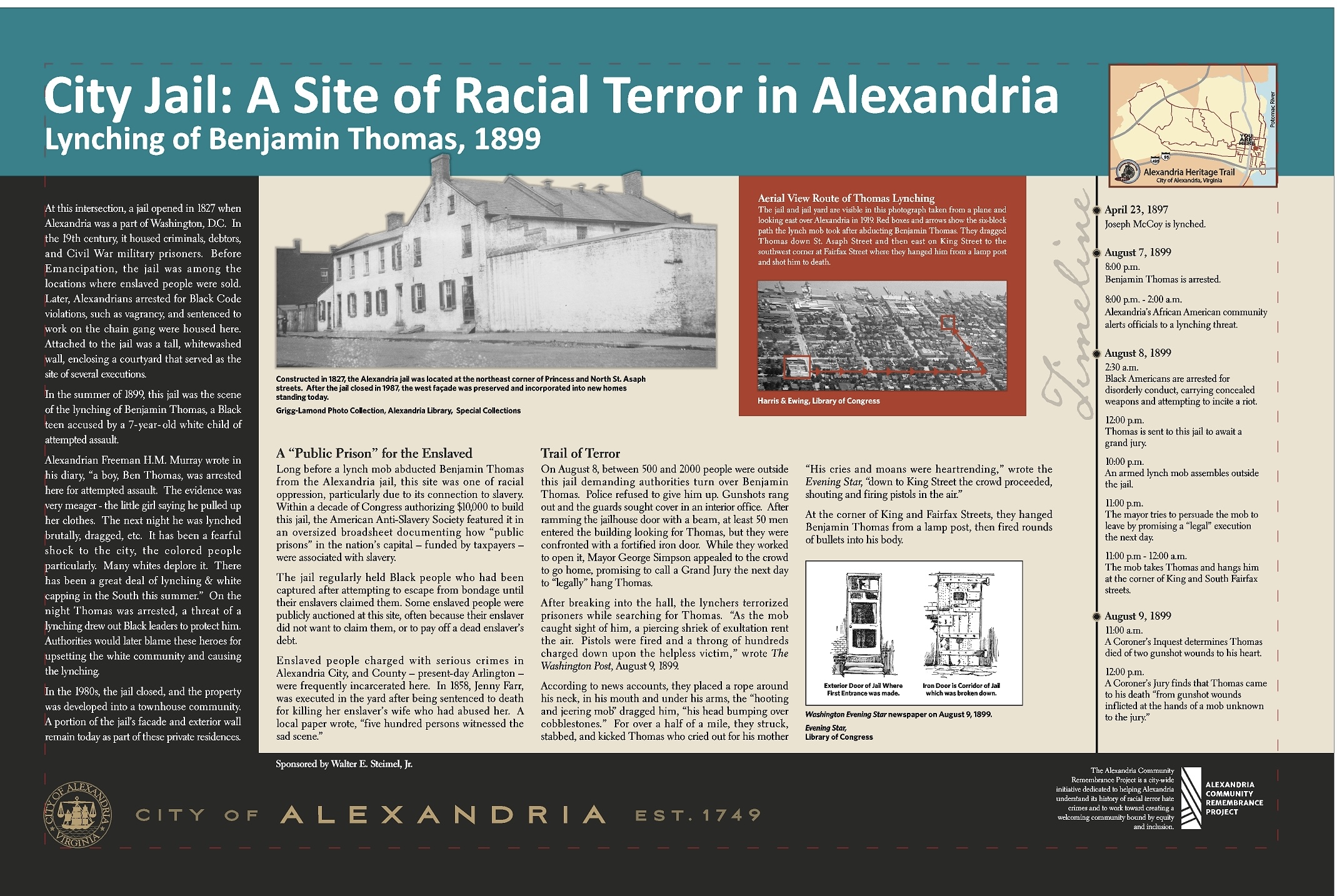

City Jail: A Site of Racial Terror in Alexandria
This sign stands at the northeast corner of Princess and North St. Asaph streets. On August 8, 1999, a mob broke into the jail and dragged Benjamin Thomas from his cell, hanging him from a lamp post at King and Fairfax streets.
The Lynching of Benjamin Thomas August 8, 1899
Below is the text for the historic marker installed in 2021 at the site of the lynching, near the corner of King and Fairfax streets. Thank you to the members of the ACRP Soil and Marker Committee as well as the ACRP Research Committee for their dedicated and thoughtful work on the development of this marker and remembering the life of Benjamin Thomas.
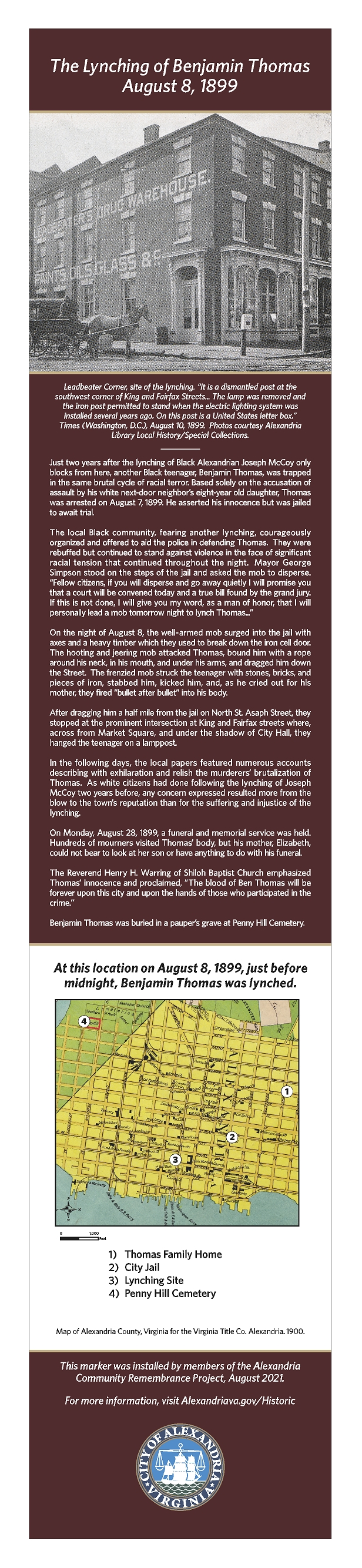
The Lynching of Benjamin Thomas
August 8, 1899
Photo Caption: Leadbeater Corner, site of the lynching. "It is a dismantled post at the southwest corner of King and Fairfax Streets... The lamp was removed and the iron post permitted to stand when the electric lighting system was installed several years ago. On this post is a United States letter box." Times (Washington D.C.), August 10, 1899. Photo Courtesy Alexandria Special Collections Library.
Close to Midnight on Tuesday, August 8 1899, Benjamin Thomas, a 16-year-old Black Alexandrian, was lynched from a lamppost on this corner.
Earlier, white rioters attacked the City Jail on N. St. Asaph Street, where they seized and dragged Thomas for a half-mile on a cobblestone street, hitting him with bricks, iron, and stones, as he cried out for his mother. Under the shadow of City Hall and the police station, he was stabbed, kicked, shot, and hanged.
On Monday, August 7, 1899, police had arrested Thomas on the word of an eight-year-old white neighbor and charged him with assaulting her.
When Alexandria's Black community learned of Thomas' arrest, they feared another lynching. Two years earlier, a white mob murdered a local Black teenager, Joseph McCoy, based on similar allegations. Attempting to protect Thomas from such a fate, groups of Black men organized, offering their aid to police. The police and Alexandria's mayor, George Simpson, ridiculed their concerns.
Mayor Simpson stood on the steps of the jail and asked the mob to leave, saying, "Fellow citizens, if you will disperse and go away quietly, I will promise you that a court will be convened today.... If this is not done, I will give you my word, as a man of honor, that I will personally lead a mob tomorrow night to lynch Thomas...."
The police arrested many in the Black community that night and the mayor sentenced them to heavy fines or jail time. Yet, no whites were held accountable for the lynching of Benjamin Thomas.
After the brutality inflicted on Thomas, his body was taken to Demaine funeral home on King Street. His mother, Elizabeth Thomas, "could not bear to look upon her boy." At the memorial service at Shiloh Baptist Church, a crowd of 600 people heard Rev. Henry H. Warring proclaim Thomas an honest boy, innocent of the crime that led to his lynching.
After Thomas was interred at Penny Hill Cemetery, the Black community mobilized to assist the Thomas family to raise funds to move his body from a pauper's grave into Douglass Cemetery, but the relocation was not recorded. There is still a question as to the final resting place of Benjamin Thomas.
The Lynching of Joseph McCoy April 23, 1897
Below is the text for the historic marker installed in 2021 at the site of the lynching, at the southeast corner of Cameron and Lee Streets.
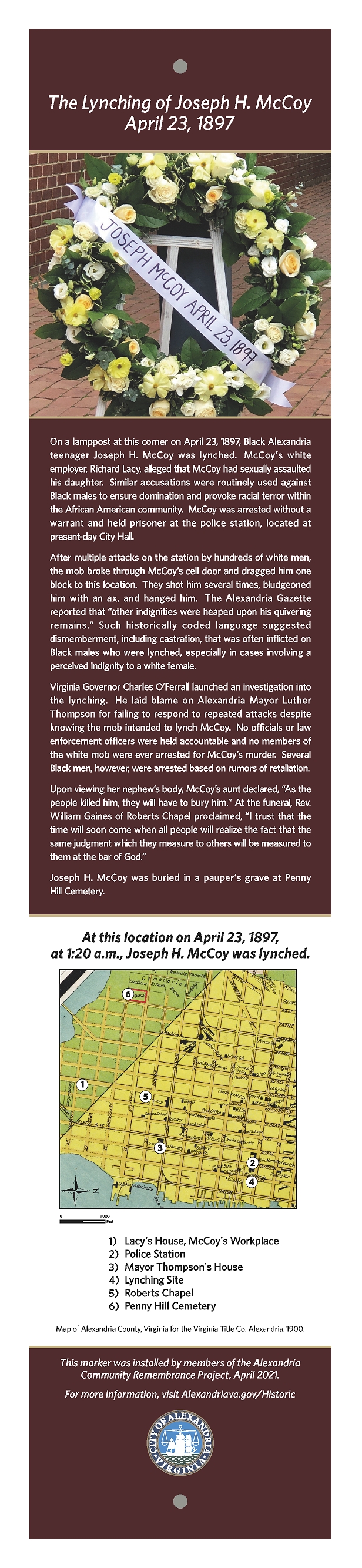
On a lamppost at this corner on April 23, 1897, Black Alexandria teenager Joseph H. McCoy was lynched. McCoy’s white employer, Richard Lacy, alleged that McCoy had sexually assaulted his daughter. Similar accusations were routinely used against Black males to ensure domination and provoke racial terror within the African American community. McCoy was arrested without a warrant and held prisoner at the police station, located at present-day City Hall.
After multiple attacks on the station by hundreds of white men, the mob broke through McCoy’s cell door and dragged him one block to this location. They shot him several times, bludgeoned him with an ax, and hanged him. The Alexandria Gazette reported that “other indignities were heaped upon his quivering remains.” Such historically coded language suggested dismemberment, including castration, that was often inflicted on Black males who were lynched, especially in cases involving a perceived indignity to a white female.
Virginia Governor Charles O’Ferrall launched an investigation into the lynching. He laid blame on Alexandria Mayor Luther Thompson for failing to respond to repeated attacks despite knowing the mob intended to lynch McCoy. No officials or law enforcement officers were held accountable and no members of the white mob were ever arrested for McCoy’s murder. Several Black men, however, were arrested based on rumors of retaliation.
Upon viewing her nephew’s body, McCoy’s aunt declared, “As the people killed him, they will have to bury him.” At the funeral, Rev. William Gaines of Roberts Chapel proclaimed, “I trust that the time will soon come when all people will realize the fact that the same judgment which they measure to others will be measured to them at the bar of God.”
Joseph H. McCoy was buried in a pauper’s grave at Penny Hill Cemetery.