
APD responds to City Council questions from the September 8, 2026 legislative meeting.
AUDITING AND OVERSIGHT
Q: What does the audit actually do? Does it verify entered case numbers against the case management system? Does it look at patterns, e.g. the same plate queried repeatedly by the same user, searches outside an officer's assigned work, unusual volume?
A: APD established a formal auditing process and auditing requirements for the ALPR system at the inception of the program. Responsibility for conducting these audits is assigned to a policing unit within the Technology Services Division, who completes an audit of all APD employee activity within the system every 30 days.
The ALPR system maintains a systemwide audit log documenting user activity. As part of the monthly audit, the policing unit reviews system usage to ensure that each search is appropriately documented with an offense type, case or incident number, and an approved search reason. The supervisor also reviews activity for potential discrepancies or unusual patterns that may warrant further examination, including repeated queries of the same vehicle by the same user, searches that appear unrelated to an employee’s assigned duties, unusually high query volume, inconsistencies between case information and the stated purpose of a search, or other activity that appears outside normal use. When identified, these inquiries are researched further to determine whether the activity was appropriate and authorized.
The results of each audit are documented in an established audit log and forwarded to the Commander of the Technology Services Division for additional review and records retention. Monthly results of auditing are also documented in a report sent to the Office of the Chief. Issues resulting from human error, documentation deficiencies, or a need for additional training are addressed through supervisory follow-up and, when appropriate, remedial training. Repeated errors or recurring training deficiencies are escalated through the employee’s chain of command for further review, corrective action, and potential suspended access. If identified, any activity suggesting intentional, inappropriate, unlawful, or otherwise serious misuse of the system would be immediately elevated to the Commander of the Technology Services Division and the Office of Professional Responsibility for further review and appropriate action.
Q: Regarding the 56 instances identified during audits over the last three years, were any determined to involve nefarious or improper use?
A: APD’s audit process reviews ALPR searches to ensure they are associated with a legitimate and approved law enforcement purpose.
Of the 56 instances identified for additional review over the three years, APD found no instance in which the ALPR system was misused for an improper, unauthorized, or non-legitimate law-enforcement purpose. The most common issues identified involved missing or mistyped case numbers resulting from clerical error.
Q: What is the timeline for a third-party audit?
A: APD supports third-party review and is working to expand its existing audit framework to advance accountability. To accomplish this goal, APD has engaged Dr. Robin Engel, a nationally recognized criminologist and policing researcher at The Ohio State University, to help develop a model for reviewing APD’s ALPR practices and audit processes.
Subject to the requirements of Virginia Code § 2.2-5517, which limits the sharing of ALPR system data and audit-trail data with private or commercial entities, a traditional third-party audit using the underlying system data and audit records is not permissible by law.
Dr. Engel will work with APD to develop a comprehensive audit methodology that incorporates independent expertise, providing a structured framework for evaluating ALPR use and compliance.
Q: What protections are in place to prevent ALPR data from being used to track women seeking abortions?
A: APD does not support the use ALPR technology for this purpose, as it is unlawful. This story originated from a state outside of Virginia. Furthermore, APD limits access to its ALPR network to select Virginia law enforcement partners, all of whom are subject to Virginia law and applicable constitutional protections. Using ALPR data to track individuals for seeking lawful reproductive health care would fall outside an authorized, legitimate law enforcement purpose and therefore would be unlawful.
Q: Could the Office of the Independent Police Auditor have a role in conducting ALPR searches or reviewing their use?
A: The Independent Police Auditor could potentially play a role in reviewing APD’s ALPR audit reports, pending legal review and subject to the authority provided by City ordinance and any guidance or direction from City Council.
CONTRACTUAL REQUIREMENTS
Q: What would it take to end the current Flock Safety contract, what would that process look like, and what are the next steps?
A: The City may stop service by Flock Safety at any time. If the City elected to transition to another provider, the process would require coordination with fiscal, legal and procurement staff and would depend on applicable procurement requirements, available alternatives, implementation timelines, and other operational considerations.
Q: When did the Flock Safety contract start, and when does it end?
A: The City first contracted through Insight Public Sector for Flock Safety cameras in 2023. The current contract term with Insight Public Sector expires in April 2027.
Q: Does “audit results” mean the underlying search logs or a summary prepared by the department?
A: APD audit records include both the underlying system activity as well as the department’s review and summary of those records.
VENDOR EVALUATION AND PROCUREMENT
Q: What is the timeline for evaluating third-party ALPR alternatives?
A: APD is evaluating ALPR alternatives, including their capabilities, data-control features, and ability to meet public safety needs. A specific timeline has not yet been established and will depend on the scope of the evaluation, community engagement, procurement requirements, and available alternatives. APD will provide additional details as the process progresses. The department is meeting with vendors in the upcoming weeks.
DATA ACCESS, SHARING AND RETENTION
Q: Do privately owned Flock Safety cameras in Alexandria - such as those operated by HOAs, businesses, or apartment complexes - share data with APD? If so, what controls apply?
A: Access to privately-owned ALPR cameras is permission-based and determined by the camera owner. Private entities may choose to share their ALPR data with APD, but that sharing is one-way. APD does not share its law-enforcement ALPR data with private entities. Any privately sourced data accessed by APD remains subject to applicable law and Department policy and is not retained by APD unless it becomes associated with a criminal investigation.
Q: Does APD receive camera feeds or shared ALPR data from private entities, including Northern Virginia Community College (NVCC)?
A: Certain private entities in Alexandria elect to share their ALPR data with APD, while others do not. Northern Virginia Community College (NVCC) does not share its ALPR data with APD. Any private sharing with APD is voluntary and one-way, and APD does not share its law-enforcement ALPR data with private entities.
Q: Can APD restrict or revoke access to its ALPR data, including access by agencies with 287(g) agreements?
A: By law, APD may only share access to its ALPR network with Virginia law enforcement agencies. APD retains the ability to further restrict or revoke access at any time. Of the 24 Virginia law enforcement agencies reported by DHS as having some form of 287(g) agreement, 12 are Flock Safety customers. APD has proactively restricted access for those 12 agencies with 287(g) agreements.
Q: How much ALPR data is currently held beyond 21 days under that exception? Who authorizes each extension, and is that decision logged and auditable?
A: Virginia law establishes the requirements governing how long ALPR data may be retained, and APD follows those requirements. ALPR data may be retained beyond 21 days only when it is associated with a criminal investigation. If that data becomes part of a criminal investigative record or evidence, its continued retention is then governed by applicable Library of Virginia records-retention requirements. APD follows legal retention requirements as established. Any ALPR data retained beyond 21 days is removed from the Flock Safety system and transferred to APD’s digital evidence management system. Once transferred, the data is no longer shared through, or accessible from, the Flock Safety network.
Q: How does APD control access to its ALPR data by other jurisdictions, and what happens when a search does not meet our standards?
A: APD controls which law enforcement agencies have access to its shared ALPR data and can restrict or revoke access at any time. APD is also evaluating additional controls, including whether outside agencies should be required to contact APD directly to conduct certain searches. Such a process may require additional staffing to provide coverage across all shifts and hours. All law enforcement queries into APD’s ALPR data is governed by Virginia Code § 2.2-5517. The law limits searches to specified law enforcement purposes, including criminal investigations where there is reasonable suspicion that a crime was committed, active missing or endangered person or human-trafficking investigations, and authorized alerts involving matters such as outstanding warrants, stolen vehicles, or stolen license plates. Searches outside those authorized purposes are prohibited by law.
Q: Does the 21-day retention policy risk destroying potential evidence before victims—particularly women and young people experiencing sexual or domestic violence—have an opportunity to report? How does the policy account for delayed reporting?
A: Delayed reporting or the time needed to develop actionable investigative leads can affect any criminal investigation. In sexual and domestic violence cases, experience has shown that reporting delays may extend for weeks, months, or longer. Because Virginia law requires ALPR data to be purged after 21 days unless it is associated with an active case, a shorter retention period could limit the ability to recover information relevant to an investigation before a report is made or a viable lead is developed. For example, during June and July 2025, APD investigated a series of indecent sexual acts across Del Ray, Rosemont, North Ridge, and Old Town. ALPR technology provided vehicle-location information that helped investigators connect incidents and identify a repeat offender who was arrested in August. That investigation extended beyond 60 days.
SYSTEM CAPABILITIES & SEARCH CONTROLS
Q: Can ALPR database be searched using vehicle characteristics without a plate number?
A: ALPR data can be searched by license plate or by broad vehicle characteristics, including make, model, color, visible damage, or distinctive stickers. This capability can be important when investigators have only a general vehicle description from a witness, victim, or video. Those characteristics can be used to narrow potential matches and develop investigative leads.
DEPLOYMENT RATIONALE
Q: How did auto-theft patterns influence camera placement, and how does APD ensure cameras are placed based on public-safety needs rather than neighborhood demographics?
A: The 2023 ALPR deployment was initiated in response to an upward trend in stolen vehicles and the broader criminal activity often associated with stolen vehicles, including weapons offenses, aggravated assaults, robberies, and burglaries. Camera placement was based on crime patterns, transportation networks, connections to surrounding jurisdictions, and other public-safety and investigative needs. APD was deliberate in developing a deployment methodology that supported its public-safety objectives while remaining consistent with Department and community values. APD proactively engaged the Office of Race and Social Equity and the Independent Policing Auditor, sought community feedback, reviewed crime and traffic data, and considered the City’s race and social equity mapping when evaluating camera locations and deployment.
Q: Why is ALPR geographical coverage concentrated in certain areas?
A: APD’s ALPR cameras are distributed across the City, with placement intended to provide broad geographic coverage without concentrating cameras in any one area. ALPR cameras are generally located along major public thoroughfares and key ingress and egress points, where traffic volume and regional travel patterns provide the greatest public-safety and investigative value. Placement is also coordinated to complement regional law enforcement partners and avoid unnecessary duplication, recognizing that criminal activity often crosses jurisdictional boundaries. Roadway design, lane configuration, traffic volume, and technical limitations can also affect the number and placement of cameras at a given location. In addition, all proposed camera locations are subject to the City’s permitting process, and not every location is physically or operationally suitable for installation.
APD was deliberate in developing a deployment methodology that supported its public-safety objectives while remaining consistent with Department and community values. APD proactively engaged the Office of Race and Social Equity and the Independent Policing Auditor, sought community feedback, reviewed crime and traffic data, and considered the City’s race and social equity mapping when evaluating camera locations and deployment.
Q: Can APD stop sharing ALPR data altogether or determine access on a case-by-case basis?
A: APD controls which law enforcement agencies can access its ALPR data and can restrict or revoke access at any time. APD could also require outside agencies to contact the Department directly for individual searches - however, implementing that process would require additional personnel to provide coverage across all shifts and hours. Ending or significantly restricting data sharing could also affect APD’s reciprocal access to ALPR data from partner agencies, which would need to be considered as part of any change to the current sharing model.
TECHNOLOGY INVENTORY
Q: What types of cameras does APD use and for what use?
A: APD uses several camera technologies for different public-safety and enforcement purposes:
- Parking Enforcement ALPR: 10 vehicle-mounted systems used for automated parking enforcement.
- Body-Worn Cameras: 628 cameras, providing approximately two per officer plus backup cameras, used as wearable recording devices.
- Red-Light Cameras: 6 cameras at four intersections used for traffic-safety enforcement.
- Speed Cameras: 7 cameras located in school zones and used for traffic-safety enforcement.
- Automatic License Plate Readers (ALPR): 61 operational fixed cameras used for legitimate law-enforcement and public-safety purposes.
- In-Car Cameras: 70 dashboard-mounted cameras and prisoner-compartment camera systems installed in police vehicles.
- Public Safety Cameras: 43 total systems, including 27 pole-mounted cameras and 5 mobile trailers; 11 are currently inoperable.
ALTERNATIVES
Q: Are there ALPR alternatives that operate like speed cameras—capturing images only when a specific legal violation occurs—and could be deployed in a more limited, community-supported manner?
A: Current research has not identified a readily available ALPR technology that operates in precisely that manner. APD is continuing to evaluate alternative technologies and approaches that may address the City’s operational, privacy, and governance requirements.
Q: What resources, policy changes, and technology alternatives are needed to address the concerns raised?
A: APD is working with City partners to identify technology solutions that meet the City’s requirements for privacy protections, governance, and operational standards. APD will also evaluate any policy changes necessary to support those requirements.
APD currently has the capacity to conduct community engagement, evaluate and procure an alternative vendor, and develop a broader technology-governance framework. Any additional personnel or funding requirements will be identified based on direction provided by City Council.
TRANSITION PLANNING
Q: How will APD engage the community as the City transitions away from Flock Safety?
A: APD supports meaningful, two-way engagement with the community and will continue engaging residents as the City evaluates the future of the ALPR program. APD is developing a strategic outreach plan and implementation timeline to support ongoing discussion, gather community feedback, and inform next steps. APD has identified two tentative dates to begin community listening and engagement sessions: September 24 and October 7. The events will be in locations convenient to residents on both the east and west sides of the city.
MAPPING
Q: Council has provided direction to publish a map of the camera locations. When can a map be posted?
A: By October 1, 2026, a map will be published.
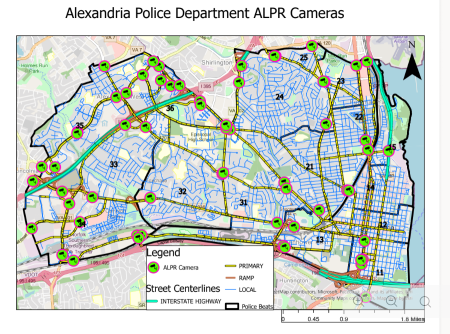
Alexandria Police Department ALPR Cameras Map
ADDITIONAL QUESTIONS
Q: Over the past 12 months, how many arrests, stolen vehicles recovered, firearms seized, and missing persons located as directly attributed to LPRs? Out of how many total searches? What is the total number of arrests, stolen vehicles recovered, firearms seized, and missing persons located during the same period *This question was subsequently updated by council.
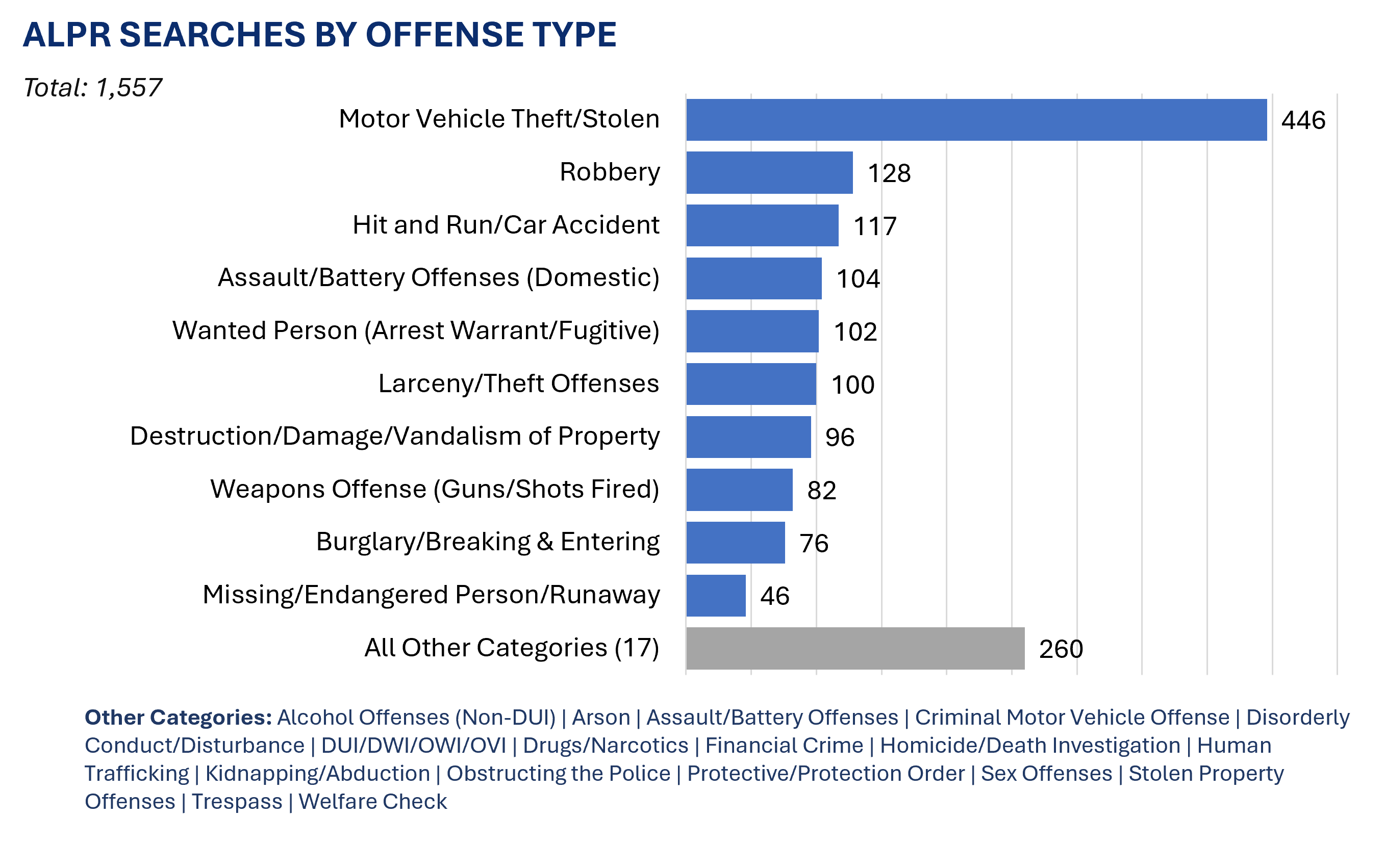
A: Between August 1, 2025, and August 31, 2026, the Alexandria Police Department used License Plate Reader (LPR) technology to assist in criminal investigations, stolen vehicle and tag recoveries, firearms investigations, and missing person cases. During this period, APD officers conducted 20,914 LPR queries.
LPR technology produced a direct impact across several investigative categories.
- APD made 2,694 criminal arrests during the reporting period. Of those cases, LPR technology directly contributed to investigations resulting in 72 felony charges and 65 misdemeanor charges.
- APD recovered 161 stolen vehicles, of which 35 were recovered as a direct result of LPR technology. APD also recovered 8 stolen license plates or tags.
- APD recovered 35 firearms related to a criminal offense during the reporting period, of which 4 were seized as a direct result of LPR technology.
- APD located 3 missing persons as a direct result of LPR technology.
These results represent the combined impact of ALPR technology and other public safety strategies employed by APD in the 12-month period from August 2025 to August 2026, including proactive enforcement, targeted deployment, investigative follow-up, and broader crime-reduction initiatives.
Q: And what does 'directly attributed' mean — who makes that determination and by what method?
A: “Directly attributed” means that an ALPR alert or specific ALPR query-initiated law enforcement action by an officer. This designation is determined through a manual review conducted by a policing unit within the Technology Services Division and the Crime Analysis Unit. The review includes an examination of the underlying police reports, and only cases in which a direct and verifiable connection to the ALPR system is established are classified as “directly attributed.”
Q: Of the 134 stolen vehicles recovered since March 2023, how many recoveries were initiated by an ALPR hit, rather than an owner's telematics alert or a citizen report?
A: For a vehicle to be classified as “stolen,” the theft must first be reported to law enforcement. Upon receiving the report, an officer completes an Offense Report, and the information is forwarded to the Records Department. Records personnel then enter the vehicle information into both the Virginia Criminal Information Network (VCIN) and the National Crime Information Center (NCIC) databases. Through direct integration with the ALPR system, the vehicle is automatically added to an ALPR “hot list.”
APD recovers stolen vehicles and tags through a variety of methods, including officer observations, citizen reports, and investigative activity. APD recovered 395 stolen vehicles and tags from March 2023 through January 2026, 134 of which were a direct result of APDs use of ALPR technology.
Q: How does the placement of APD’s ALPR cameras relate to auto-theft patterns across the city, particularly given the 2023 deployment in response to a rise in stolen vehicles?
A: This map represents APD’s fixed ALPR camera locations, overlayed with three years of auto-theft density, between 2023–2026, demonstrating how current camera locations relate to auto-theft patterns across Alexandria.
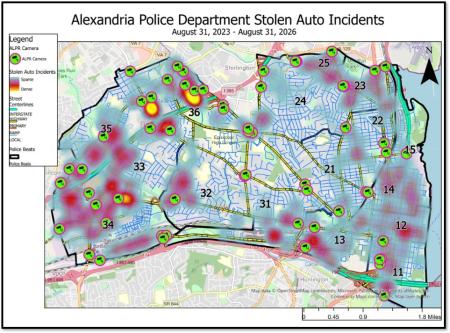
Alexandria Police Department Stolen Auto Incidents [Updated]
Q: What is the difference between APD’s Flock ALPR cameras and the City’s red-light cameras?
A: Flock ALPR cameras are investigative tools used to collect license plate information and vehicle characteristics for legitimate law-enforcement purposes, including developing investigative leads, identifying vehicles associated with criminal activity, and locating missing or endangered persons. Pursuant to Code of Virginia § 2.2-5517(D), Flock ALPR cameras may be used only: (1) as part of a criminal investigation supported by reasonable suspicion that a crime has been committed; (2) as part of an active investigation involving a missing or endangered person; or (3) to receive notifications authorized by law. System data associated with an ongoing criminal investigation, prosecution, or civil action shall be retained until the conclusion of the applicable investigation, prosecution, or civil action. System data that is not associated with an ongoing criminal investigation, prosecution, or civil action shall be purged within 21 days of the date of capture. Access to and use of ALPR information shall be limited to authorized personnel and used only for purposes permitted by law and applicable City policy. Flock ALPR cameras are distinct from and operate independently of the City's automated Red-Light and school-zone Speed Cameras. ALPR technology is an investigative law-enforcement tool, whereas automated Red-Light and Speed Cameras are civil traffic-enforcement tools.
Automated Red-Light Cameras operate in conjunction with traffic signals to detect and document specified traffic violations. When a violation is detected, the system may capture two or more photographs, video recordings, or other recorded images of the vehicle involved. The City's use of automated Red-Light Cameras is governed by Code of Virginia § 15.2-968.1. If the City or its authorized third-party vendor does not issue a summons for a detected violation within 10 business days of the violation, all information associated with that violation shall be purged within two business days, as required by law. Where a summons is issued, information associated with the violation shall be retained only for the period authorized by applicable law and City records-retention requirements.
Automated Speed Cameras are civil traffic-enforcement tools deployed in designated school zones to detect and document violations of applicable speed limits. The City's use of automated Speed Cameras is governed by Code of Virginia § 46.2-882.1. If a summons for a detected violation is not issued within 30 days of the date of the violation, all information collected in connection with that violation shall be permanently purged and destroyed within 60 days, as required by law. The City's authorized third-party vendor, Verra Mobility, is currently responsible for performing the applicable data-purging functions.
Information collected through automated Red-Light and Speed Cameras shall be limited to that necessary for the authorized civil traffic-enforcement purpose and shall not be used as a substitute for, or treated as equivalent to, investigative ALPR data.
Q: How do red-light cameras collect and retain data, and how is that data used?
A: In accordance with Code of Virginia § 46.2-882.1, information collected through red-light camera systems should be limited to information reasonably necessary for the detection, investigation, and enforcement of violations of traffic-control signals. Such information shall be accessed, used, retained, and disclosed only for purposes authorized by law and applicable City policy. If a summons is issued for a violation, information pertaining to that specific violation may not be retained for more than 60 days after the collection of any associated civil penalties. If a summons is not issued within 10 business days of the violation, the locality shall purge all information related to that violation within two business days.
Access to red-light camera information shall be limited to authorized personnel with a legitimate law-enforcement or administrative need consistent with the purpose for which the information was collected. Any disclosure or use of the information shall comply with applicable law and City policy. Upon expiration of the applicable retention period, the information shall be securely purged or destroyed in accordance with applicable law and City records-management requirements.
Automatic License Plate Reader Transparency
APD uses ALPR technology only for legitimate law enforcement purposes, consistent with Virginia law and APD policy. Key safeguards include:
- ALPR searches must have a legitimate law enforcement purpose, such as a criminal investigation or missing person case.
- ALPR data is not used for immigration enforcement.
- Access is limited to trained and authorized personnel only.
- All searches are documented, tracked, and regularly audited.
- ALPR data is retained for 21 days, consistent with Virginia law and APD policy.
- APD does not provide ALPR data access to federal agencies or law enforcement agencies outside Virginia without a valid court order.
Our goal is to responsibly use every lawful tool available to help solve crimes, deliver justice for victims, and protect the community while respecting constitutional rights and maintaining public trust.
What type of alerts do police officers receive?
Alerts received
- Stolen vehicle
- Stolen license plate
- Missing person
- Warrants (person with active warrants for their arrest)
- Felony vehicle (vehicle involved in felony crimes)
- Custom alert (used to enter vehicles recently involved in a crime and not yet entered in NCIC)
Alerts NOT received
- Immigration related enforcement
- Driver's license or registration violations
- Civil infractions or civil warrants
- Parking violations
- Tax related violations
What happens when an ALPR generates an alert?
An ALPR alert is an investigative lead, not automatic confirmation that a vehicle or person is involved in criminal activity.
Before taking enforcement action, APD officers must confirm the accuracy and nature of the alert. Officers may verify that the license plate or other identifying characteristics of the vehicle match the information that generated the alert and confirm that the underlying information remains active.
An ALPR alert alone does not automatically provide grounds to stop a vehicle.
What can officers search the ALPR database for?
Officers can use the ALPR database to search for vehicles involved in crimes that are a violation of the Code of Virginia (Title 18.2. Crimes and Offenses Generally).
*Alexandria has 61 fixed ALPR cameras.
**Information shown reflects ALPR searches conducted in September 2026 and does not represent real-time data. Data will be updated approximately every 30 days.
Frequently Asked Questions
APD's approach to ALPR technology is governed by controls at every stage: access is restricted to authorized personnel, queries must have a legitimate law enforcement purpose, use must comply with Virginia law and APD policy, activity is documented and audited, data is subject to defined retention limits, and sharing is restricted by law.
No. APD does not use ALPR technology for civil immigration enforcement. APD enforces Virginia law and City ordinances, not federal civil immigration law. Virginia law limits ALPR searches to specifically authorized law enforcement purposes, including qualifying criminal investigations involving an alleged violation of Virginia law or a local ordinance, as well as certain investigations involving missing or endangered persons or human trafficking. Civil immigration enforcement is not an authorized purpose for an ALPR search.
Access to APD's investigative ALPR systems is limited to trained, authorized personnel with a legitimate law enforcement purpose.
Virginia law places restrictions on how ALPR information may be shared. APD does not sell ALPR data.
Sharing with other law enforcement agencies must comply with Virginia law and APD policy. APD maintains the authority to suspend or terminate data-sharing access when appropriate.
ALPR technology captures information about a vehicle when its license plate is observed, including the license plate number, the date and time of the observation, the location, and an image of the vehicle/plate. Personal identifying information (PII) about the driver or occupants of a vehicle is not captured by an ALPR. An ALPR observation does not, by itself, identify who was driving or who was inside the vehicle.
Every 30 days, the Alexandria Police Department's Mobile Computer Unit (MCU) audits internal ALPR system activity to ensure the technology and its data are accessed and used in accordance with Department policy and applicable law.
As part of the audit, MCU reviews system activity and query records, including who accessed the system, when it was accessed, and the documented purpose for the search. The review verifies that ALPR activity is connected to a documented, official, and lawful public safety purpose and helps identify potential unauthorized access, improper searches, sharing, or other misuse.
Any activity that cannot be verified or appears inconsistent with Department policy or law is referred for additional review.
ALPR database information is subject to a defined 21-day retention period by law and access controls; it is not maintained indefinitely. Under Virginia law, ALPR system data must be purged 21 days after capture.
Every ALPR database query creates an audit trail. Users must document the law enforcement purpose for accessing the system and provide information necessary to associate the search with the investigation or event.
APD's Mobile Computer Unit conducts an internal audit of APD's ALPR systems at least once every 30 days to ensure the technology is being used in accordance with Department policy and Virginia law. Any suspected discrepancies are referred for additional review. Audit trails are purged after two years unless part of an ongoing investigation, prosecution, or civil action.
Misuse is any use of ALPR equipment, databases, or data that does not strictly serve a documented, official, and lawful public safety purpose.
Policy and Law
APD's use of ALPR technology is governed by Department policy and Virginia law.
Alexandria Police Department
Directive 10.40: License Plate Reader Program
Code of Virginia
§ 2.2-5517: Use of Automatic License Plate Recognition Systems by Law-Enforcement Agencies