
Voices of Alexandria's Youth
Overview of the Developmental Assets
Asset Building Efforts in Alexandria
The Protective Power of Developmental Assets

Search Institute's studies have consistently shown that young people who experience more of the Developmental Assets engage in fewer risk-taking behaviors s and experience higher levels of thriving indicators. Developmental Assets have the power to protect youth from engaging in the 24 risk-taking behaviors listed in the table to the left.

Each vertical bar in the figure to the left represents the average number of risk-taking behaviors reported by Alexandria youth at particular asset levels.
The 40 Developmental Assets
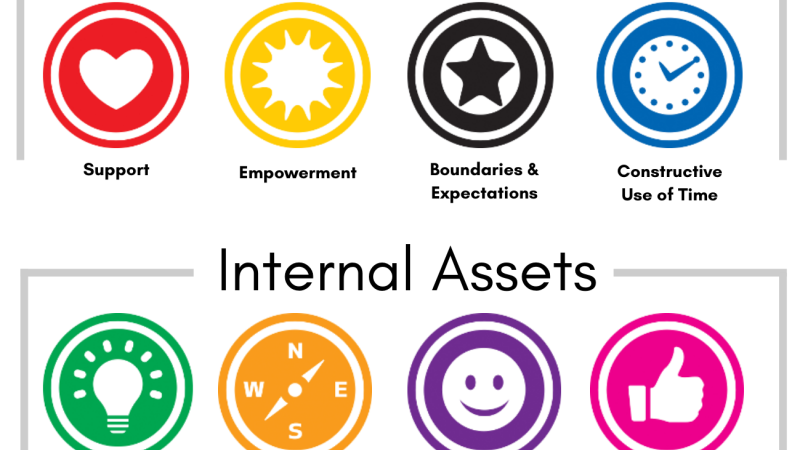
Search Institute has identified the 40 positive supports and strengths that all youth need to succeed. 20 are the supports, opportunities, and relationships that young people need across all aspects of their lives (External Assets). 20 are the personal skills, commitments, and values they need to make good choices, take responsibility of their own lives, and be independent and fulfilled.

Young people need to be surrounded by people who love, care for, appreciate, and accept them.
| Asset | % of Alexandria Youth Self-Reporting Asset in 2022 |
|---|---|
| 1. Family support - Family life provides high levels of love and support. | 70% |
| 2. Positive family communication - Young person and their parent(s) communicate positively, and young person is willing to seek parent(s) advice and counsel. | 29% |
| 3. Other adult relationships - Young person receives support from three or more nonparent adults. |
38% |
| 4. Caring neighborhood - Young person experiences caring neighbors. | 32% |
| 5. Caring school climate - School provides a caring, encouraging environment. | 31% |
| 6. Parent involvement in schooling - Parent(s) are actively involved in helping young person succeed in school. | 24% |

Young people need to feel valued and valuable. This happens when youth feel safe and respected.
| Asset | % of Alexandria Youth Self-Reporting Asset in 2022 |
|---|---|
| 7. Community values youth - Young person perceives that adults in the community value youth. | 17% |
| 8. Youth as resources - Young people are given useful roles in the community. | 25% |
| 9. Service to others - Young person serves in the community one hour or more per week. | 38% |
| 10. Safety - Young person feels safe at home, school, and in the neighborhood. | 39% |

Young people need clear rules, consistent consequences for breaking rules, and encouragement to do their best.
| Asset | % of Alexandria Youth Self-Reporting Asset in 2022 |
|---|---|
| 11. Family boundaries - Family has clear rules and consequences, and monitors the young person’s whereabouts. | 47% |
| 12. School boundaries - School provides clear rules and consequences. | 50% |
| 13. Neighborhood boundaries - Neighbors take responsibility for monitoring young people’s behavior. | 35% |
| 14. Adult role models - Parent(s) and other adults model positive, responsible behavior. | 39% |
| 15. Positive peer influence - Young person’s best friends model responsible behavior. | 83% |
| 16. High expectations - Both parent(s) and teachers encourage the young person to do well. | 56% |
Young people need opportunities—outside of school—to learn and develop new skills and interests with other youth and adults.
| Asset | % of Alexandria Youth Self-Reporting Asset in 2022 |
|---|---|
| 17. Creative activities - Young person spends three or more hours per week in lessons or practice in music, theater, or other arts. | 16% |
| 18. Youth programs - Young person spends three or more hours per week in sports, clubs, or organizations at school and/or in community organizations. | 47% |
| 19. Religious community - Young person spends one or more hours per week in activities in a religious institution. | 37% |
| 20. Time at home - Young person is out with friends “with nothing special to do,” two or fewer nights per week. | 72% |

Young people need a sense of the lasting importance of learning and a belief in their own abilities.
| Asset | % of Alexandria Youth Self-Reporting Asset in 2022 |
|---|---|
| 21. Achievement motivation - Young person is motivated to do well in school. | 68% |
| 22. School engagement - Young person is actively engaged in learning. | 80% |
| 23. Homework - Young person reports doing at least one hour of homework every school day. | 48% |
| 24. Bonding to school - Young person cares about their school. | 52% |
| 25. Reading for pleasure - Young person reads for pleasure three or more hours per week. | 25% |
Young people need to develop strong guiding values or principles to help them make healthy life choices.
| Asset | % of Alexandria Youth Self-Reporting Asset in 2022 |
|---|---|
| 26. Caring - Young person places high value on helping other people. | 70% |
| 27. Equality and social justice - Young person places a high value on promoting equality and reducing hunger and poverty. | 79% |
| 28. Integrity - Young person acts on convictions and stands up for their beliefs. | 78% |
| 29. Honesty - Young person “tells the truth even when it is not easy.” | 71% |
| 30. Responsibility - Young person accepts and takes personal responsibility. | 70% |
| 31. Restraint - Young person believes it is important not to be sexually active or to use alcohol or other drugs. | 49% |

Young people need the skills to interact effectively with others, to make difficult decisions, and to cope with new situations.
| Asset | % of Alexandria Youth Self-Reporting Asset in 2022 |
|---|---|
| 32. Planning and decision-making - Young person knows how to plan ahead and make choices. | 34% |
| 33. Interpersonal competence - Young person has empathy, sensitivity, and friendship skills. | 43% |
| 34. Cultural competence - Young person has knowledge of and comfort with people of different cultural/racial/ethnic backgrounds. | 67% |
| 35. Resistance skills - Young person can resist negative peer pressure and dangerous situations. | 50% |
| 36. Peaceful conflict resolution - Young person seeks to resolve conflict nonviolently. | 51% |

Young people need to believe in their own self-worth and to feel that they have control over the things that happen to them.
| Asset | % of Alexandria Youth Self-Reporting Asset in 2022 |
|---|---|
| 37. Personal power - Young person feels they have control over “things that happen to me.” | 29% |
| 38. Self-esteem - Young person reports having a high self-esteem. | 31% |
| 39. Sense of purpose - Young person reports that “my life has a purpose.” | 43% |
| 40. Positive view of personal future - Young person is optimistic about their personal future. | 60% |
Local Data
Every three years, Alexandria City Public Schools (ACPS) administers the Search Institute’s Profiles of Student Life: Attitudes and Behaviors Survey. The Search Institute then analyzes and shares the data. View the most recent Profile results below.
Historical Assets
2025 Results
- Developmental Assets Data for All ACPS Schools 2025
- 2025 Assets Data, Disaggregated by Race/Ethnicity
2022 Results
- Developmental Assets Data for All ACPS Schools 2022
- 2022 Assets Data, Disaggregated by Race/Ethnicity
2013-2019 Results
How to Build Assets in our Community
Successful asset-building communities are those in which adults and youth work together to create a culture of cooperation rooted in respect for all community members. Below are some ways that various groups in our community can help Alexandria become an asset-building community. This was adopted from the Search Institute’s Profiles of Student Life: Attitudes and Behaviors (2018).
Educators, youth leaders, and faith community members can do the following:
- Build assets in youth by concentrating on
- Building intergenerational relationships
- Educating and supporting parents
- Encouraging a constructive use of time
- Focusing on values development
- Emphasizing service to the community.
The focus is on both their own members and on the larger community.
- Youth-serving professionals and volunteers (such as day-care providers, teachers, social workers, religious and community youth leaders, coaches, and mentors) receive training in asset building.
- Preschool, elementary, and secondary schools place a high priority on becoming caring environments for all students. Schools provide a challenging and engaging curriculum, offer opportunities for nurturing the values that community members consider critical, expand and strengthen out-of-school activities, and connect with parents to reinforce the importance of family attention to asset building.
Young people can do the following:
- Learn about the Developmental Assets and care about increasing them by promoting asset building actions for themselves and their peers.
- Ask for opportunities to lead, make decisions, and offer their knowledge and ideas to others. They are empowered to take on useful roles in community life.
- Actively participate in developing community programs and policies, rather than function as passive objects of adult programming.
- Engage frequently in service to other people, often partnering with adults. The community highly values the service-learning that comes from these experiences.
- Most 7- to 18-year-olds are involved in one or more clubs, teams, or other youth-serving organizations that make asset building central to their mission.
- Establish and sustain healthy relationships with younger children.
All caring adults, including parents, community residents, business people, elected representatives, and organization members can do the following:
- Create safe places for youth to meet and hang out.
- Assume personal responsibility for developing sustained, caring, intergenerational relationships with young people and building assets by taking the following concrete actions:
- Listening carefully
- Sharing respectful conversation
- Enjoying their company and distinguishing them by name
- Complimenting positive behaviors
- Acknowledging youth when they’re present
- Involving youth in decision-making.
- Identify and share with youth a core set of common values and boundaries. Adults model and articulate these positive values and boundaries to young people.
- Believe in the importance of building Developmental Assets in youth. Communicate that message several times a year to all residents.
- Support families and adults (particularly parents) with community programs that teach and equip adults to make asset building a top priority.
- Invest in expanding and strengthening the community system of youth clubs, teams, and organizations.
- Elevate peer helping, mentoring, and service-learning programs, all of which intentionally build assets, to top priority within the community and expand them to reach a larger number of youth
- Ensure that businesses that employ teenagers deliberately address the Support, Boundaries and
Expectations, Positive Values, and Social Competencies assets in the workplace. - Encourage employers to develop family-friendly policies in the workplace and provide processes for employees to build healthy relationships with youth.
- Train youth organizations and other service provider leaders and volunteers in asset-building strategies. Provide meaningful opportunities for youth to serve their communities and build
citizenship and leadership skills. - Move asset development and community-wide cooperation to the top of local government planning, policy, and funding priorities through policy-making, influence, training, and resource allocation.
- Consistently and repeatedly communicate a vision for healthy youth through local, regional, and national media (including print, radio, television, and Internet). Public relations efforts support local asset-building efforts. The media provide forums for sharing innovative actions taken by individuals and organizations.
- Take pride in and share with youth the community’s cultural strengths and traditions, including
- Showing respect for elders and authority figures
- Nurturing intergenerational relationships
- Caring for others
- Understanding the wisdom about “what matters.”
Affirming these strengths represents an important dimension of cultural competence, in addition to knowledge and contact with cultures outside one's own.
- Offer frequent expressions of support to young people in informal public settings and in formal gathering places.
- Recognize and celebrate the innovative actions of asset-building individuals and systems. Youth professionals and volunteers experience a high status in the life of the community.
- Make a community-wide commitment to asset building that is long-term and includes all residents.
- Pay particular attention to helping girls develop and express assertiveness skills, personal control and skill mastery, and a healthy self-concept.
- Pay particular attention to helping boys develop and express compassion, caring, and a healthy self-concept.
- Ensure that there are safe sources of short-term childcare for families on weekends and weeknights.
Search Institute Resources
The following resources are listed in the Search Institute’s Profiles of Student Life: Attitudes and Behaviors (2018), Appendix D.
Coming into Their Own: How Developmental Assets Promote Positive Growth in Middle Childhood by Peter C. Scales, Ph.D., Arturo Sesma, Jr., Ph.D., and Brent Bolstrom (2003)
This book provides research findings from studies on the development of children in grades four through six. This guide helps parents and other adults understand what programs, policies, and practices are most effective in raising healthy kids during the critical middle childhood years.
Developmental Assets Profile (DAP)
The DAP survey is designed for youth in grades 6 through 12. It measures the eight Developmental Assets categories in a convenient format that can be scored by the survey administrator across five interpersonal areas to better understand how young people fare personally and socially within the family, school, and community.
Developmental Assets: A Synthesis of the Scientific Research on Adolescent Development by Peter C. Scales, Ph.D. and Nancy Leffert, Ph.D. (2004)
Examines more than 800 scientific articles and reports on adolescent development that are linked to each Developmental Asset. This book is an invaluable reference that demonstrates the strong scientific foundation undergirding the asset framework and reveals what is known about how assets are built and their impact on various youth populations.
The Best of Building Assets Together: Favorite Group Activities That Help Youth Succeed by Jolene Roehlkepartain (2008)
Presents 150+ “best of the best” activities for groups of young people ages 12 to 18. Games and projects energize, inspire, and allow participants to explore family communication, school climate, peer relationships, service-learning, self-esteem, leadership, diversity, and community involvement. Includes tips from educators and youth providers and a CD with over 50 reproducible handouts in English and Spanish.
Great Places to Learn: Creating Asset-Building That Schools Help Students Succeed by Neal Starkman, Ph.D., Peter C. Scales, Ph.D., and Clay Roberts, M.S. (2006)
Rooted in many years of research about the effectiveness of assets, this foundational book for educators shines as a powerful, positive guide to infusing assets into any school community.
Assets to Go! (2006; mini-poster)
Show them your commitment with this colorful display poster of the 40 Developmental Assets. Bright colors and graphics make it an eye-catching message that your youth are important.
Instant Assets: 52 Short and Simple E-mails for Sharing the Asset Message (2007; CD-ROM)
Would you like to send out a weekly asset message? Now it's easy—we've done the work for you with 52 ready-made e-mail messages. Send messages on their own, or add them to your organization's existing communication, whether it's e-mail, Web-based, or print!
Take It Personally by Jolene Roehlkepartain (2017)
This action and reflection workbook contains everything individuals need to make a stronger commitment to children and teenagers. Ideal for staff meetings, parent groups, volunteer trainings, and community events, this concise journal helps people from all walks of life learn about the power they have to make a difference for young people.
What’s Up with Our Kids?
A Search Institute facilitator presents your survey results and helps build a shared understanding of young people’s strengths and needs. Contact Search Institute Training and Speaking for more information at 1–800–888–7828.
Building Developmental Assets in School Communities
A strong introductory workshop to inspire and motivate everyone in your school community! This training makes the connection between assets and student success, and demonstrates how everyone can play a positive role in helping youth thrive.
Essentials of Asset Building for Trainers and Facilitators
Learn to deliver two core workshops, Everyone’s An Asset Builder and Sharing the Asset Message. Use local expertise to spread the good word about the power of Developmental Assets.
Everyone’s an Asset Builder
This workshop introduces participants to Search Institute’s internationally-recognized research on the strengths and supports that enable young people to thrive. The workshop examines the power of individuals in shaping the lives of youth and the central role of relationships in building the Developmental Assets that all young people need.
ParentFurther.com
Visit parentfurther.com for a wealth of free parenting resources by Search Institute, including the “Everyday Parenting Ideas” newsletter that addresses various parenting challenges. Also includes many other useful tools for parents.
Sparks: How Parents Can Ignite the Hidden Strengths of Teenagers by Peter L. Benson, Ph.D. (2008)
Describes a simple yet powerful plan for awakening the “spark” that lives within every young person. Sparks—when recognized and nurtured—give teenagers joy, energy, and direction. They can transform a young person's life from survival mode to thriving mode. Grounded in new research conducted with thousands of teenagers and parents, Sparks offers a step-by-step approach to helping all teenagers discover their unique gifts.
150 Ways to Show Kids You Care (2014; mini-poster)
Discover 150 great ideas to make kids feel special every day. Even the simplest acts of kindness can build assets in the lives of children and teens. You’ll find plenty of ideas on the mini-poster and in the 84-page book by the same name. Poster and book offer adults easy, meaningful ideas to show kids they really care. Bilingual.
Parenting at the Speed of Teens (2004)
A portable guide to positive, commonsense strategies for dealing with both the everyday issues of parenting teenagers—junk food, the Internet, stress, friendships—as well as the serious ones—depression, divorce, racism, and substance abuse. Illustrates how the “little things” such as talking one-on-one, setting boundaries, offering guidance, and modeling positive behavior—can make a big difference in helping a teenager be successful.
Raising Kids with Care: 50 Ways to Help Your Whole Family Thrive (2006; mini-poster)
A list of comforting, practical tips and reminders intended to help parents and guardians build assets in their children and take care of themselves. Filled with thoughtful insights and realistic reminders, it offers a much- needed boost to the daily life of parents.
Contact Info
For general questions about the Developmental Assets Data/Survey, please contact Noraine Buttar at Noraine.Buttar@alexandriava.gov
For information about Developmental Assets training opportunities, please contact Dr. Temi Aregbesola at Temi.Aregbesola@alexandriava.gov