
Ship Conservation: Iron Fasteners and X-ray Technology
March 2021
The team at the Conservation Research Lab continues to work on the ship remnant found at the Hotel Indigo Site (44AX229). Conservators are still working on manually and chemically removing iron fasteners and corrosion and are close to being finished with this task. This is an important step in the conservation process and one that takes a great deal of time. If iron is not fully removed from the timber, the rest of the conservation process will not be as effective, and the artifact is at risk of deterioration in the future. Many of the timbers are still in ammonium citrate baths, which helps chelate (or break down) iron concretions. Once all the iron is removed, conservators will impregnate the timbers with polyethylene glycol (PEG) and then freeze dry them.
Conservators are also manually driving out pins, nails, and spikes. This is sometimes a slow process and a balancing act. It requires simultaneously applying enough force to remove the fastener while not damaging the surrounding wood. They’ve also used micro-air grinder to grind down the exposed heads of fasteners and a pneumatic air-scribe to pulverize concretions inside fastener holes. A few pins are posing additional challenges that the CRL team is trying a variety of techniques to extract.
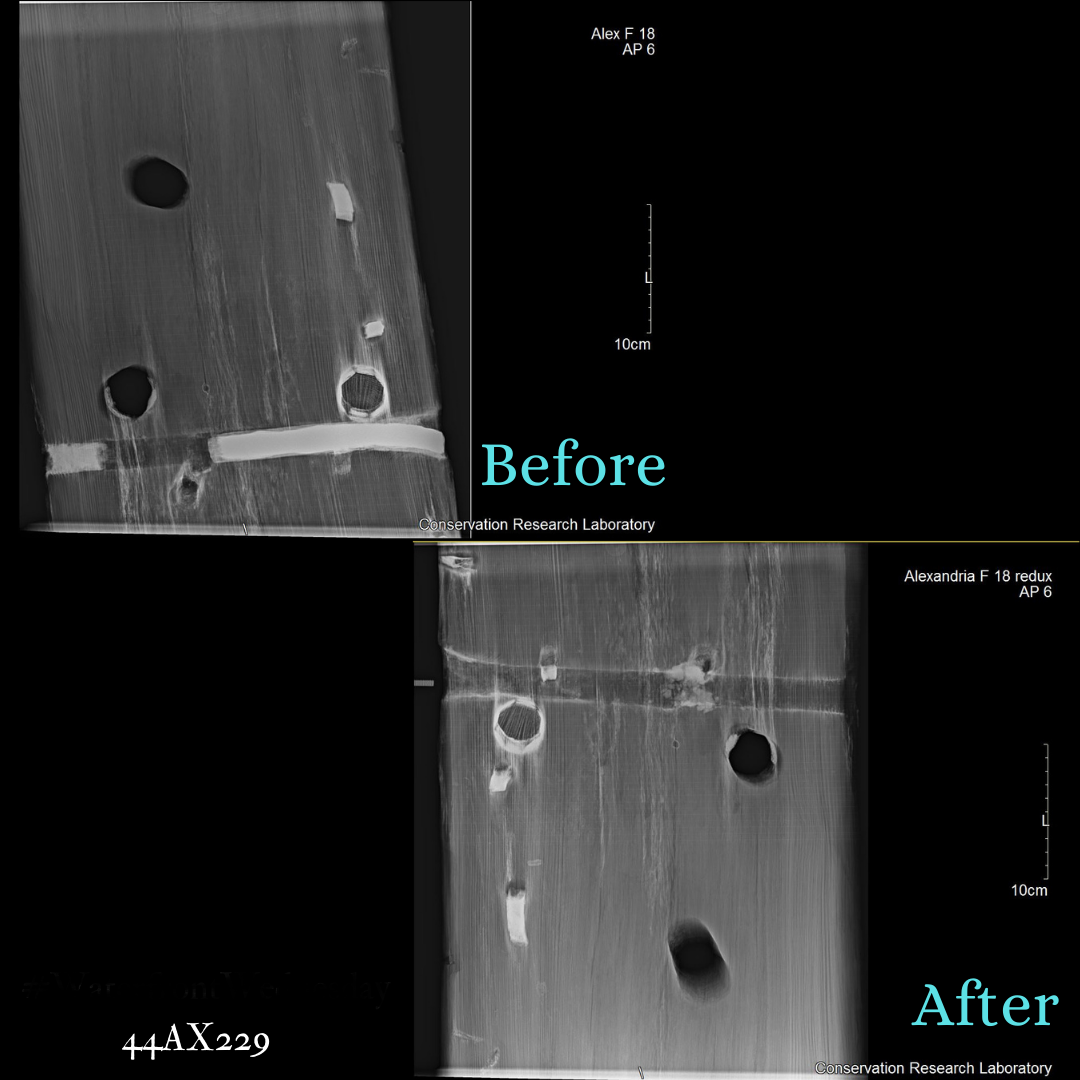
The team is using X-ray technology to assist in removing the more stubborn iron fasteners and concretions from the timbers. X-rays help document the progress of the chelation process, showing how deeply embedded fasteners break down over time. By seeing inside the timber, conservators can make informed decisions about how to best remove pins, nails, and concretions. X-Rays help conservators make plans for extracting blind pins (pins where only one end is exposed) because they show the angle at which the pin penetrates the wood.
This before and after set of x-rays show the removal of a bolt connecting two timbers. The bright white in the before image indicates that dense metal is still present. Note that the after image does not have as much white visible, indicating that there is less metal present.