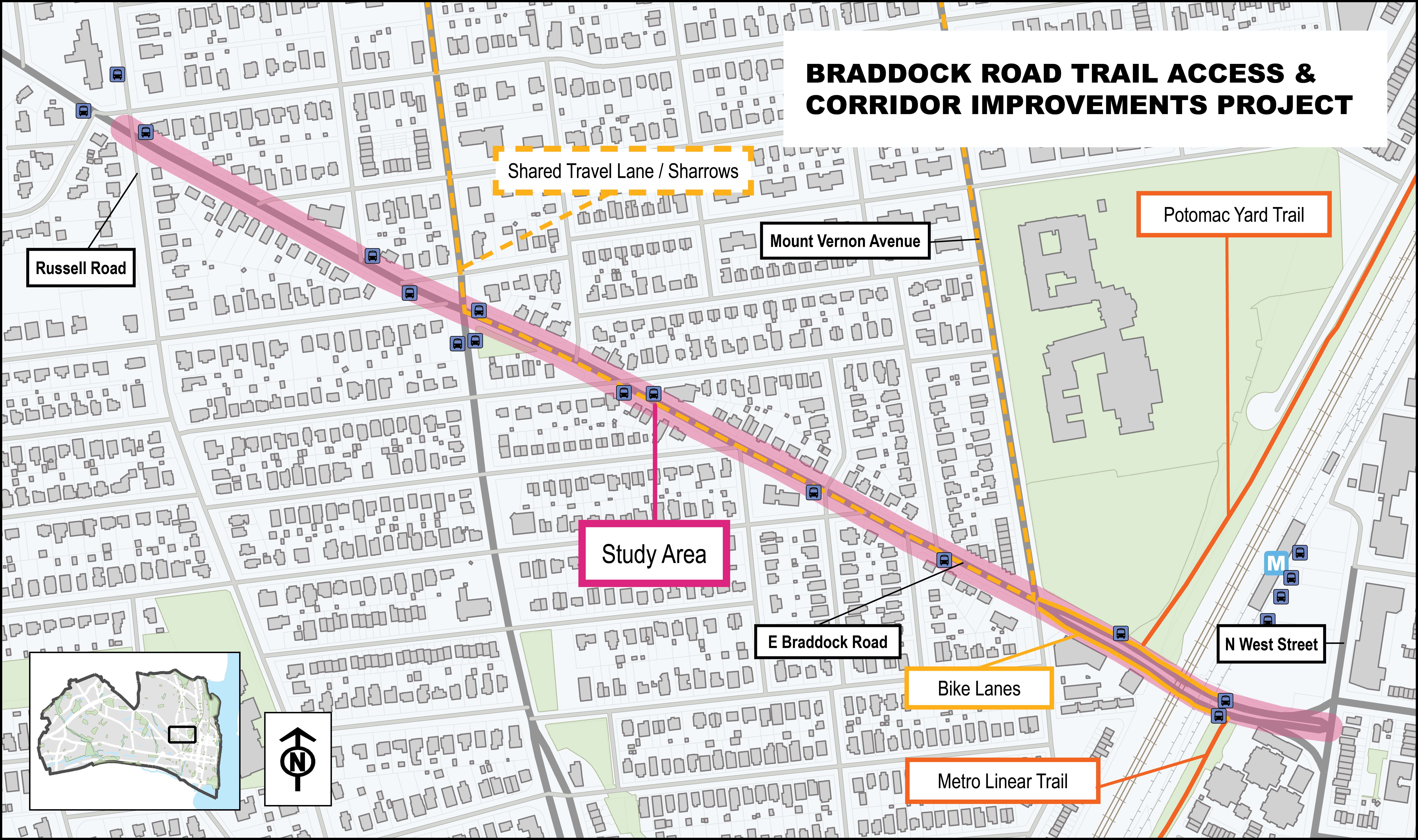

Description
The Braddock Road Trail Access and Corridor Improvements project is intended to enhance safety and accessibility for all roadway users along Braddock Road between Russell Road and North West Street. The goal is to create a more connected, comfortable, and safe corridor for walking, biking, transit, and driving while improving access to the Braddock Road Metrorail Station, Potomac Yard Trail, Metro Linear Trail, George Washington Middle School, and nearby neighborhoods and businesses.
Project Area
Background
Braddock Road is a key east–west corridor in Alexandria that connects neighborhoods, local businesses, the Braddock Road Metro station. Braddock Road also connects to the Metro Linear and Potomac Yard Trails which provide important north–south connections to Old Town, Potomac Yard, and Del Ray. The mix of people walking, biking, scooting, driving, and taking transit, especially during peak travel times, has created safety concerns at crossings and along the corridor. Residents have shared these concerns through Alex311, and a 2023 Safe Routes to School walk audit at George Washington Middle School identified the need for safety improvements. Additionally, the Virginia Department of Transportation designated the segment between Mount Vernon Avenue and North West Street as a top statewide priority for pedestrian and bicycle safety upgrades.
Project Development
Overall Project Status: Design
Planning & Concept Design
Status: Completed Spring 2026
Approved Design Concept
Alternatives Analysis:
Conceptual Design Options
Presentation on Design Options
Traffic Analysis Results
Parking Study
Crash Map
Community Engagement
Status: In Progress
May 16, 2026: City Council Public Hearing
The Alexandria City Council voted to uphold the Traffic & Parking Board's recommended design for Braddock Road, with the following changes:
- Install sidewalks to the extent feasible on Luray Avenue and Hancock Avenue adjacent to Good Shepherd Lutheran Church
- Install crosswalks to the extent feasible on Braddock Road at Luray Avenue, Hancock Avenue, Little Street, and Ramsay Street
- Preserve on-street parking on the north side of Braddock Road between Luray Avenue and Hancock Avenue adjacent to Good Shepherd Lutheran Church
The meeting materials are available below:
The City Council decision concludes the planning and conceptual design phase of the project. The project will now advance to detailed design. Check this webpage for periodic updates as the project progresses.
February 23, 2026: Traffic & Parking Board Public Hearing
The Traffic & Parking Board voted to endorse the staff recommendations for the Braddock Road Corridor Improvements Project at its February 23 Public Hearing. Meeting materials are available below:
The Traffic & Parking Board's February decision was appealed to City Council pursuant to City Code section 5-8-6(a).
Fall 2025-Winter 2026: Continued Community Engagement
Staff continued to engage ad hoc with civic associations, community groups, and residents.
Fall 2025: Comment Period on Conceptual Design Options
The City gathered feedback on conceptual design options for the project from September 10-October 5. A project open house was also held on September 17 at George Washington Middle School. Thank you for your comments!
Outreach Flyer
Press Release
ALXnow Article
Presentation on Design Options
Community Feedback Summary
Spring 2025: Initial Public Comment Period
The City collected community input on existing conditions in the project study area from March 7-21, 2025.
Outreach Flyer
Community Comment Summary
Detailed Design
Status: Initiated Spring 2026
Stay tuned for updates!
Construction
Status: Not Started; Planned for 2027
Frequently Asked Questions
The purpose of this project is to improve safety and connectivity along Braddock Road, particularly near the Metro station, trails, schools, and neighborhood destinations. The corridor was selected because it is a key east–west arterial that serves drivers, transit riders, pedestrians, and cyclists. This project addresses documented corridor issues: complex intersections with multiple conflict points, long pedestrian crossings, speeding, and gaps in safe bike connectivity—especially near the Braddock Road Metro station, trails, schools, and key neighborhood destinations.
Adopted City plans and VDOT have also identified portions of Braddock Road as a priority for pedestrian and bicycle access improvements, making it an appropriate location to address long-standing safety and connectivity needs.
Travel lane and parking modifications between West Street and Russell Road, including:
· Reducing travel lanes between Yates Corner and West Street
· Consolidating turn/through lanes at key intersections
· Removing most on-street parking between Mount Vernon Avenue and Russell Road (with limited retained segments)
· Adding loading and disability parking modifications
· Providing separated or protected space for biking where feasible
Bicycle activity is highest near the Braddock Road Metro station and existing trail connections. Volumes are lower in other segments. Transportation planning considers both existing use and future demand. Providing safe, connected facilities allows more people to consider biking, especially near high-capacity transit and schools. The goal is to improve safety and connectivity for current users while supporting future access to Metro, trails, and neighborhoods.
No, this proposal is a safety and corridor-operations project with multimodal elements. Key benefits include shorter crossings, fewer driver turning conflicts, clearer lane organization, and safer access to high-demand generators (Metro, trails, schools, bus routes).
Between Russell Road and Mount Vernon Avenue, the corridor includes 105 on-street spaces. Parking studies found peak observed usage of 28 vehicles on a weekday evening and 47 vehicles on a Sunday morning, with over 300 available spaces on nearby streets within 1–2 blocks during those peak observations.
Most homes fronting Braddock Road have off-street parking. Adjustments were made to retain some parking and relocate or augment the disability space near Good Shepherd Lutheran Church.
A traffic analysis was conducted using accepted engineering methodologies. The modeling evaluated current and projected conditions at signalized intersections. With signal timing adjustments, the recommended design is expected to operate similarly to existing conditions. The analysis found no significant increase in overall vehicle delay compared to today.
The intersection Level of Service (LOS) grade reflects average vehicle delay per cycle, not corridor-wide congestion. The PM peak hour was used because it represents the most constrained condition.
Signal timing adjustments are incorporated into the recommended design. However, signal timing alone does not address long pedestrian crossing distances, multiple-turn-lane conflict points, or gaps in bicycle connectivity. The proposed design improves safety through physical changes that reduce conflict points and shorten exposure for people crossing the street. While signal timing alone might help with peak hour congestion, it is not a holistic approach to designing streets for everyone.
Between 2019 and 2023, there were 17 crashes within the project area, 16 at intersections and 8 resulting in injury. One crash involved a pedestrian. A pedestrian fatality occurred at Braddock Road and Commonwealth Avenue in 2015.
Vision Zero and the Safe System approach emphasize preventing severe crashes before they occur by addressing known risk factors such as long crossings, multiple threat situations, and complex intersections.
Braddock Road is a continuous east-west arterial connecting Metro, trails, schools, and neighborhoods. Alternative residential streets do not provide the same direct access or network continuity.
Transportation plans adopted by the City identify Braddock Road as part of the planned bicycle network to create safe, connected routes instead of isolated facilities.
It is not a mandate, but VDOT identified the segment between Mount Vernon Avenue and West Street as a statewide priority area for pedestrian and bicycle improvements. The City evaluated the entire corridor based on safety, connectivity, and planning goals. The project is being recommended by City staff and will be considered by the Traffic & Parking Board at a public hearing.
The design includes defined loading areas and clarified lane configurations to reduce unpredictable stopping in travel lanes. Today, drivers already encounter turning vehicles, buses, and delivery activity. The modeling accounted for current traffic patterns and expected operational conditions.
The project included multiple rounds of engagement and meetings with neighborhood groups and stakeholders. Based on feedback, staff removed the West Alexandria Avenue direction change from consideration, retained limited on-street parking segments where needed, and coordinated disability parking adjustments. A Traffic & Parking Board Public Hearing was held on February 23, 2026, and a City Council Public Hearing was held on May 16, 2026.
The Traffic & Parking Board voted unanimously to endorse the staff recommendation at its February 23, 2026 public hearing. Subsequently, that decision was appealed to City Council. At its May 16, 2026 Public Hearing, City Council voted to uphold the Traffic & Parking Board's recommendation with the following changes:
- Install sidewalks to the extent feasible on Luray Avenue and Hancock Avenue adjacent to Good Shepherd Lutheran Church
- Install crosswalks to the extent feasible on Braddock Road at Luray Avenue, Hancock Avenue, Little Street, and Ramsay Street
- Preserve on-street parking on the north side of Braddock Road between Luray Avenue and Hancock Avenue adjacent to Good Shepherd Lutheran Church