You're logged in with MyAlex  |  Logout

City of Alexandria, VA

Search results cleared

Include archived pages
Most of the content here is written in English. Translate your search to find more content? Translating "" to English... Searching for English phrase ""
  • Live
  • Play
  • Services
  • Business
  • Government
  • Projects & Plans
  • Calendar
  • I want to…

Hotel Indigo Conservation Update: Conservation Continues

The team at the Conservation Research Lab (CRL) are continuing treatment of the ship remnant to remove the remaining iron pins and spikes before polyethylene glycol (PEG) and freeze drying of the wood begins.
Page updated on August 16, 2022 at 5:06 PM

Alexandria Archaeology

  • Historic Alexandria (Home)
  • About Historic Alexandria
  • Educational Resources
  • Events and Experiences
  • Explore Alexandria's History
  • Plan Your Visit
  • Rentals
  • Support Us/Get Involved
  • Alexandria Archaeology
    • Alexandria Archaeology (Home)
    • Alexandria Archaeological Commission
    • Alexandria Archaeology Bibliography
    • Archaeological Process
    • Archaeology and Alexandria's First People
    • Archaeology and Preservation
    • Archaeology on the Waterfront
    • Documentary Research and Historical Archaeology

Share

Bluesky Share on Facebook Share on X Share via Email
Translate icon
Translate icon
XWARNING: You have chosen to translate this page using an automated translation system. This translation has not been reviewed by the City of Alexandria and may contain errors.

Conservation Continues

August 2022

Conservation work continues on the ship remnant found at the Hotel Indigo Site (44AX229).  Several metal fasteners, including four drift pins that held the keel and frames together and other spikes, are still proving stubborn and have not been removed. The wet, swollen wood combined with the iron concretion within the fastening holes and the high rate of preservation of the fasteners makes it essentially impossible to remove the pins and spikes either by constant pressure or sharp hits. The team at the Conservation Research Lab (CRL) tried using a hydraulic ram to drive out the remaining drift pins. Unfortunately, this strategy did not work in budging them at all. Conservators decided that it was safer to stop the procedure rather than push harder because more pressure would risk harming the timber.
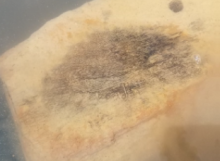
Dark wood timber with lighter color iron sediments on the surface.
Timber with sedimented iron particles on the surface. The darker area in the center is the timber surface, and the lighter color material is iron sediments. Photo courtesy of Texas A&M University's Conservation Research Lab.

Instead, the team at the CRL refreshed the ammonium citrate solution that the timbers are soaking in to draw out (chelate) more iron from the wood. This additional soaking time was more than these timbers were initially predicted to need. However, this treatment was necessary, and the wood continued to leach out iron particulates that settled on the surface of the timbers. The current plan for removing the stubborn pins and spikes is to continue soaking the timbers for the remainder of the summer and possibly refreshing the chelation solution one more time. Then all of the ship timbers will be saturated with polyethylene glycol (PEG) and freeze dried. The freeze-drying process should hopefully shrink the wood somewhat, creating a small space between the timber and the remaining metal fasteners. Then these pins and spikes should be able to be mechanically removed. Conservators will then apply a poultice in the fastening holes to draw out as much remaining iron as possible from these areas. 

Contact Us
Alex311 | 703.746.4311
Follow Us
  • BlueSky
  • Facebook
  • X
  • YouTube
Visitor Information

VisitAlexandriaVA.com

  • Jobs
  • Payments
  • Departments
  • Newsroom
  • Social Media
  • Emergency Hotlines
  • Accessibility
  • FOIA Requests
  • Privacy & Legal
City of Alexandria Seal
© 1995–2023 City of Alexandria, VA and others.
Hold on, redirecting...