
Technology Tells a Story
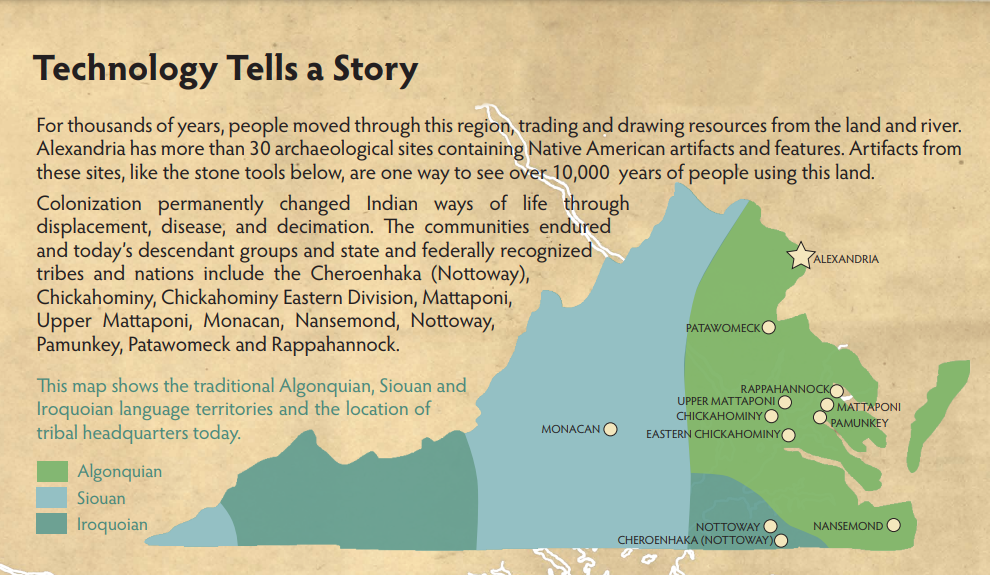
For thousands of years, people moved through this region, trading and drawing resources from the land and river. Alexandria has more than 30 archaeological sites containing Native American artifacts and features. Artifacts from these sites, like the stone tools below, are one way to see over 10,000 years of people using this land.
Colonization permanently changed Native American ways of life through displacement, disease, and decimation. The communities endured and today’s descendant groups and state and federally recognized tribes and nations include the Cheroenhaka (Nottoway), Chickahominy, Chickahominy Eastern Division, Mattaponi, Upper Mattaponi, Monacan, Nansemond, Nottoway, Pamunkey, Patawomeck and Rappahannock.
This map shows the traditional Algonquian, Siouan and Iroquoian language territories and the location of tribal headquarters today. This exhibit was made possible with the help from the Friends of Alexandria Archaeology and the Pamunkey Indian Tribe.
Technology Changes Over Time
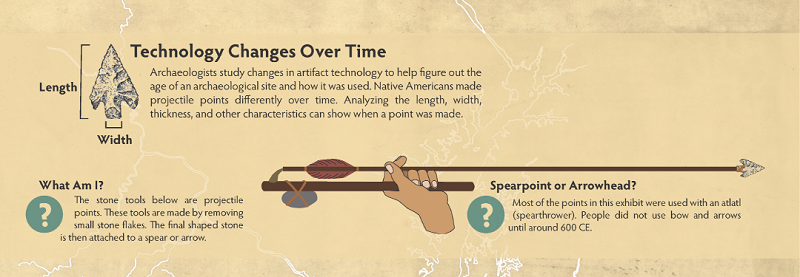
Archaeologists study changes in artifact technology to help figure out the age of an archaeological site and how it was used. Native Americans made projectile points differently over time. Analyzing the length, width, thickness, and other characteristics can show when a point was made.
What Am I?
The stone tools below are projectile points. These tools are made by removing small stone flakes. The final shaped stone is then attached to a spear or arrow.
Spearpoint or Arrowhead?
Most of the points in this exhibit were used with an atlatl (spearthrower). People did not use bow and arrows until around 600 CE.
Projectile Point Timeline
Paleoindian Period (15,000 – 8,000 BCE)
People used this area seasonally for hunting and fishing.
Example Projectile Point Listed:
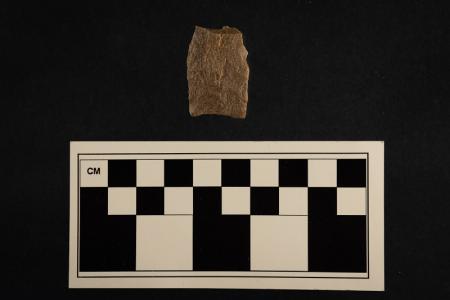
Ca. 13,000 years ago, Freedmens Cemetery (44AX179)
Is this a Clovis point?
Only the base of this point remains. Breaks like this are common and make identification difficult. Other artifacts found in the same place can help with identification, but this one was found alone. Analyzing the length, width, thickness, and other characteristics suggests that this is a Clovis point. Clovis points are identified by the shape of the base, blade, and flute of the channel.
Archaic Period (8,000 BCE – 1000 BCE)
People lived in small groups. They hunted and gathered resources seasonally across the Ice Age landscape.
Example Projectile Points Listed:
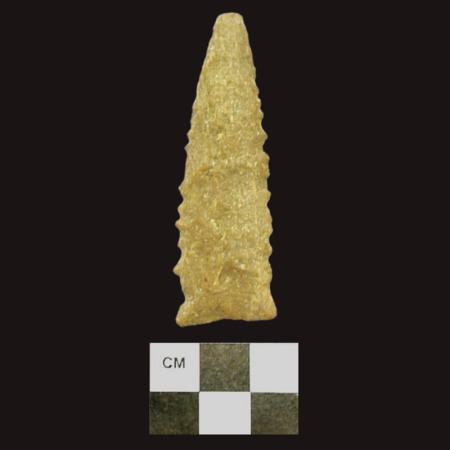
6200 – 5700 BCE, Jones Point (44AX185)
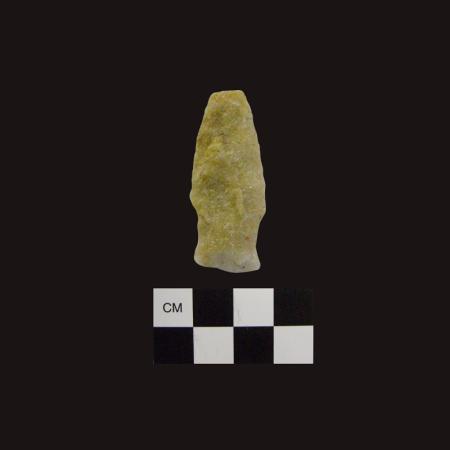
2500 – 1500 BCE, Freedmens Cemetery (44AX179)
Early & Middle Woodland (1000 BCE – 900 CE)
People lived in towns. They hunted and gathered resources.
Example Projectile Point Listed:
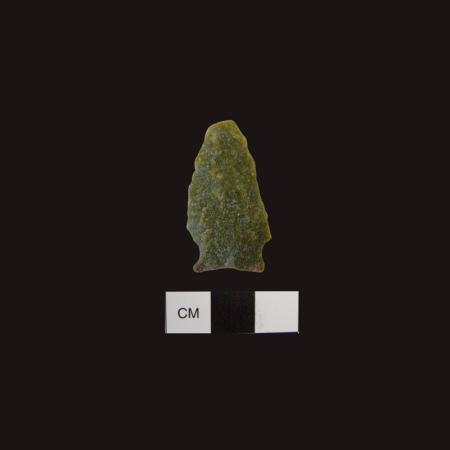
500 – 900 CE, Freedmens Cemetery (44AX179)
Late Woodland Period (900 CE – 1600 CE)
There was a rise of societal hierarchy and Tribal power. People lived in towns. They farmed, hunted, and gathered resources.
Example Projectile Point Listed:
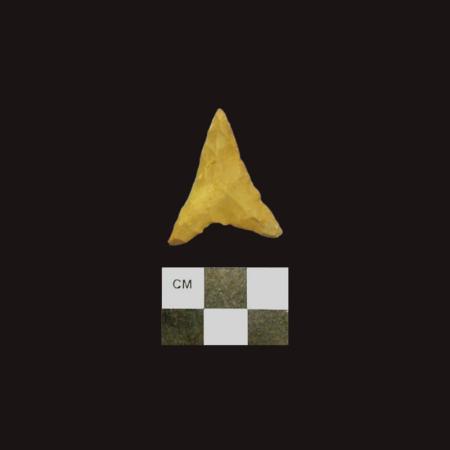
500 – 1300 CE, Jones Point (44AX185)
Today
There are 11 Virginia State Recognized Tribes, of which 7 of these Tribes are federally recognized.
The fight for state and federal recognition continues today. Tribal sovereignty means indigenous groups have rights as members of domestic dependent nations and can govern according to their own traditions, laws, and leadership structures. In 2018, six more tribes joined the Pamunkey with federal recognition.
Where are these artifacts from?
These points are from two archaeological sites: Jones Point and Freedmens Cemetery. The sites were desirable locations near water. Archaeologists conducted work at both sites as part of the Wilson Bridge project.
Jones Point Site is on the banks of Hunting Creek. The site included artifacts from the Archaic Period, as well as evidence of two Woodland Period structures. The Freedmens Cemetery Site is on a bluff overlooking Hunting Creek. It had evidence from the Paleoindian, Archaic, and Woodland Periods. The historic cemetery was not excavated during the project.
More to the story
There is so much more to the story than stone tools. Virginia Native American heritage spans more than 10,000 years and continues today. Archaeologists, working collaboratively and respectfully, can contribute evidence of a history that has been forgotten and distorted over centuries of racism.