You're logged in with MyAlex  |  Logout

City of Alexandria, VA

Search results cleared

Include archived pages
Most of the content here is written in English. Translate your search to find more content? Translating "" to English... Searching for English phrase ""
  • Live
  • Play
  • Services
  • Business
  • Government
  • Projects & Plans
  • Calendar
  • I want to…

Preserving Alexandria’s Maritime Heritage

Visit this exhibit in the Alexandria Archaeology Museum
Page updated on March 4, 2023 at 11:02 AM

Alexandria Archaeology

  • Historic Alexandria (Home)
    • The Museums
      • Museum Collections
      • Rentals and Private Events
    • Other Historic Sites
    • Alexandria Community Remembrance Project
    • Alexandria's History
    • Educational Resources
    • Historic Preservation
    • Museum Store
    • Self-Guided Tours
    • Stay Connected
    • Support Historic Alexandria
  • About Historic Alexandria
  • Alexandria Archaeology (Home)
  • Alexandria Archaeological Commission
  • Archaeological Process
    • Alexandria Archaeology Bibliography
    • Documentary Research and Historical Archaeology
  • Archaeology and Alexandria's First People
  • Archaeology and Preservation
    • Archaeological Protection Code
    • Archaeological Standards
    • GIS Tools for the Archaeologist
    • Metal Detecting Code
    • Resource Management Firms
  • Archaeology on the Waterfront
  • Make a Gift
  • News Releases
  • Programs & Events
    • Alexandria Archaeology Summer Camp
    • Educational Resources
  • Projects and Publications
  • Visit the Museum

Share

Bluesky Share on Facebook Share on X Share via Email
Translate icon
Translate icon
XWARNING: You have chosen to translate this page using an automated translation system. This translation has not been reviewed by the City of Alexandria and may contain errors.

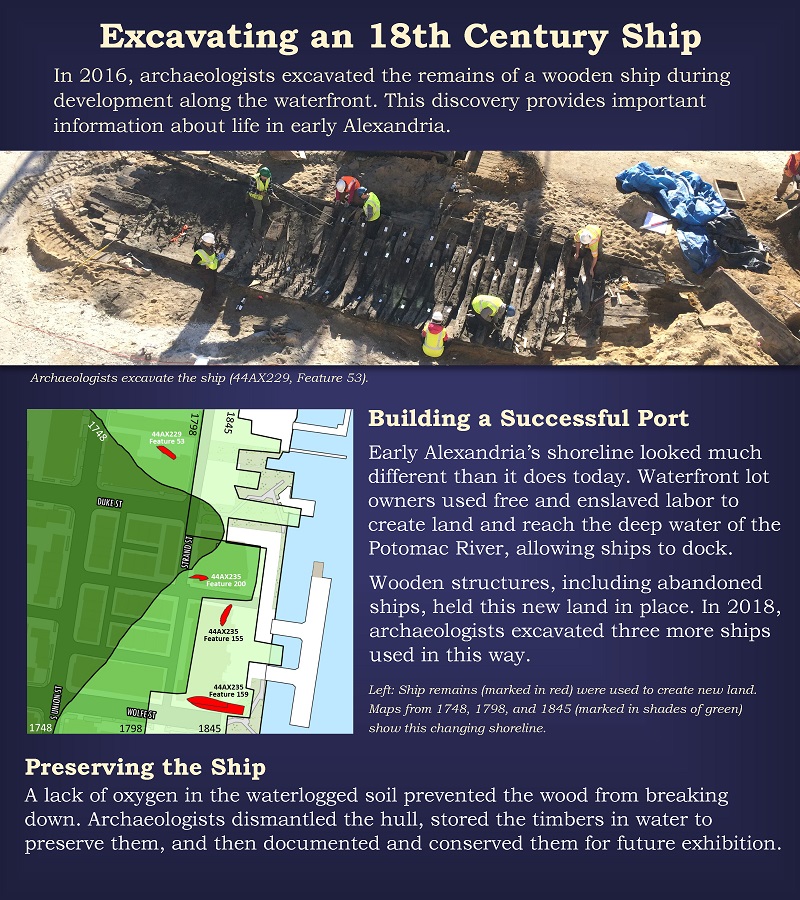
Excavating an 18th Century Ship

In 2016, archaeologists excavated the remains of a wooden ship during development along the waterfront. This discovery provides important information about life in early Alexandria.
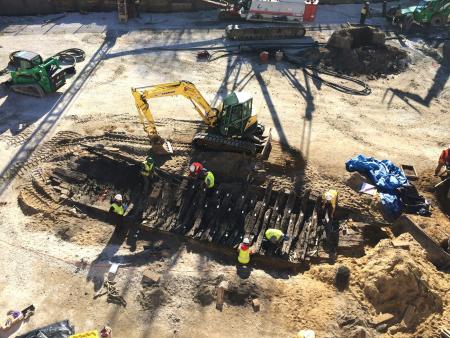
Exhibit panel


Ship discovered at the Hotel Indigo Site, January 2016
Archaeologists excavate the ship (44AX229, Feature 53)


Building a Successful Port

Early Alexandria’s shoreline looked much different than it does today. Waterfront lot owners used free and enslaved labor to create land and reach the deep water of the Potomac River, allowing ships to dock.

Wooden structures, including abandoned ships, held this new land in place. In 2018, archaeologists excavated three more ships used in this way.
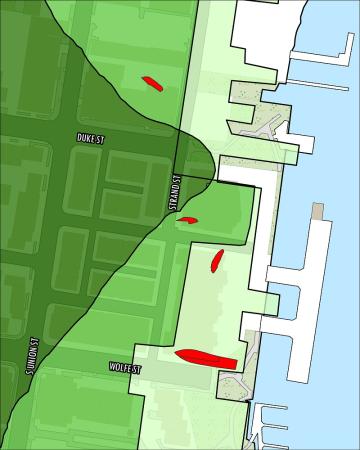
Three earlier shorelines and location of ships, on modern map.
Ship remains (marked in red) were used to create new land. Maps from 1748, 1798, and 1845 (marked in shades of green) show this changing shoreline.


Preserving the Ship

A lack of oxygen in the waterlogged soil prevented the wood from breaking down. Archaeologists dismantled the hull, stored the timbers in water to preserve them, and then documented and conserved them for future exhibition.

Learning from Ship Remains

Only a portion of the ship remained in the ground. Researchers analyzed the ship’s wood and its construction to understand what it once looked like and how it was used.
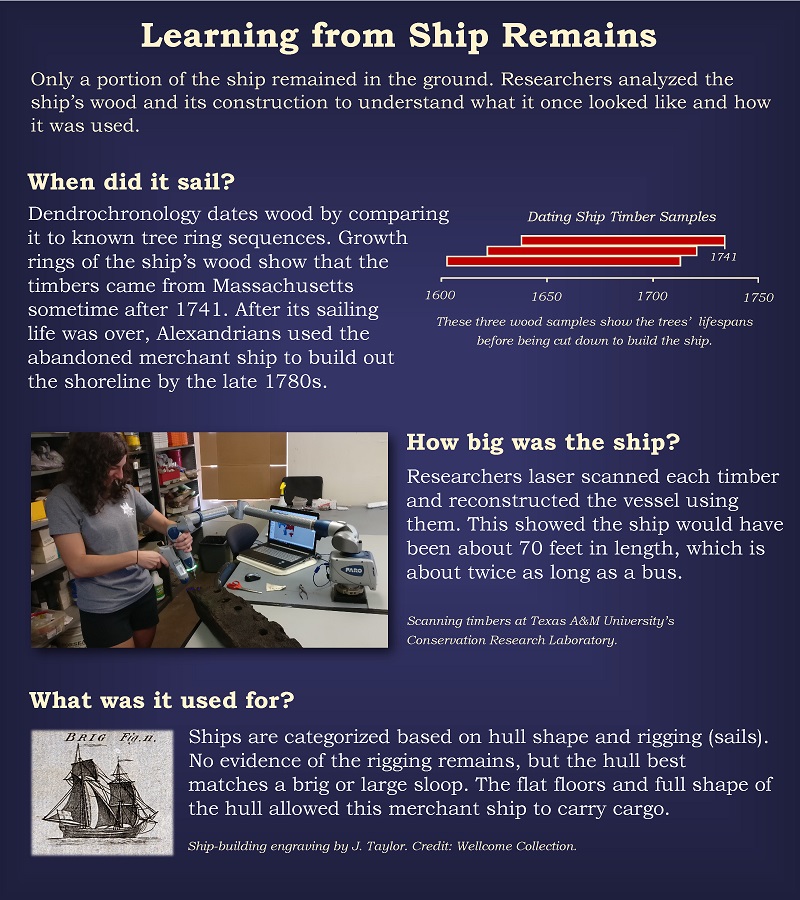
Learning from Ship Remains, exhibit panel

When did it sail?

Dendrochronology dates the wood by comparing it to known tree ring sequences. Growth rings of the ship’s wood show that the timbers came from Massachusetts sometime after 1741. After its sailing life was over, Alexandrians used the abandoned merchant ship to build out the shoreline by the late 1780s.
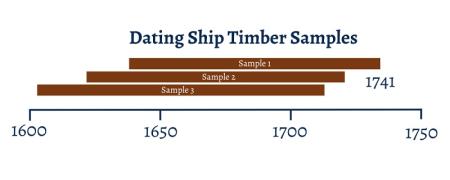
Timeline showing three samples
These three wood samples show the trees’ lifespans before being cut down to build the ship.


How big was the ship?

Researchers laser scanned each timber and reconstructed the vessel using them. This showed the ship would have been about 70 feet in length, which is about twice as long as a bus.
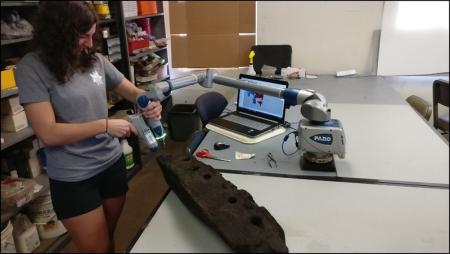
Archaeologist with timber and scanning equipment
Scanning timbers at Texas A&M University’s Conservation Research Laboratory.


What was it used for?

Ships are categorized based on hull shape and rigging (sails). No evidence of the rigging remains, but the hull best matches a brig or a large sloop. The flat floors and full shape of the hull allowed this merchant ship to carry cargo.
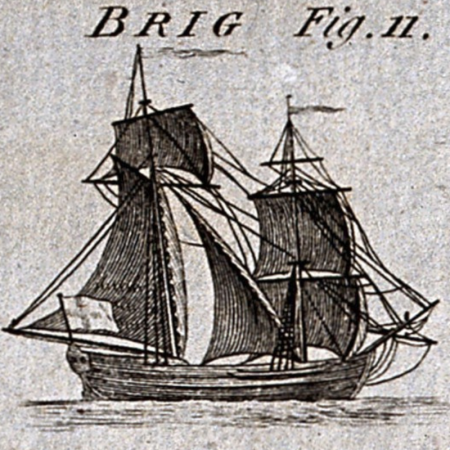
Brig drawing
Ship-building engraving by J. Taylor. Credit: Wellcome Collection.


Alexandria’s Transatlantic Reach 1784 – 1790
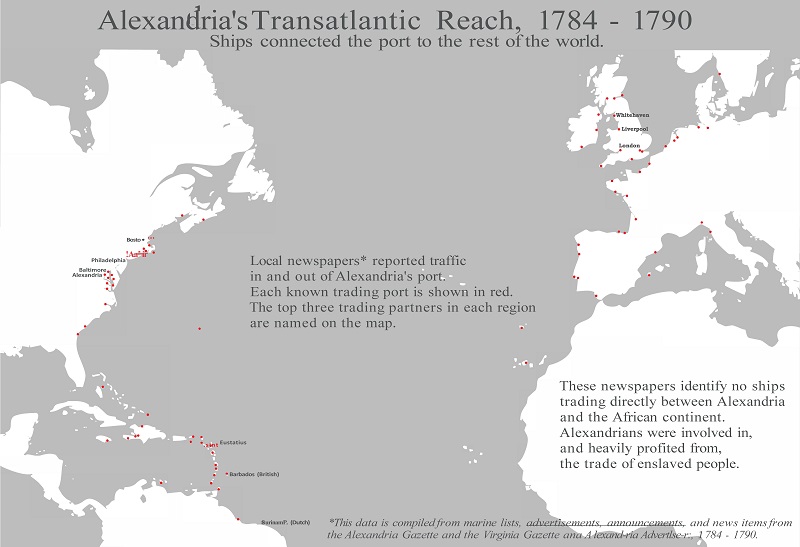
Alexandria's Transatlantic Reach. Map.

Ships connected the port to the rest of the world

Local newspapers* reported traffic in and out of Alexandria’s port. Each known trading port is shown in red. The top three trading partners in each region are named on the map.

These newspapers identify no ships trading directly between Alexandria and the African continent. Alexandrians were involved in, and heavily profited from, the trade of enslaved people.

*This date is compiled from marine lists, advertisements, announcements, and news items from the Alexandria Gazette and the Virginia Gazette and Alexandria Advertiser, 1784 – 1790.

Alexandria’s Connection to the World

By the late 18th century, the Potomac River connected the bustling port city to the world. Artifacts found on the same city block as the ship show the types of goods transported by merchant ships and used by early Alexandrians.

Alexandria mainly exported raw goods like tobacco and wheat, and imported manufactured goods from Europe and sugar from the Caribbean. The forced labor and the trade of enslaved individuals formed the foundation of this trans-Atlantic network.
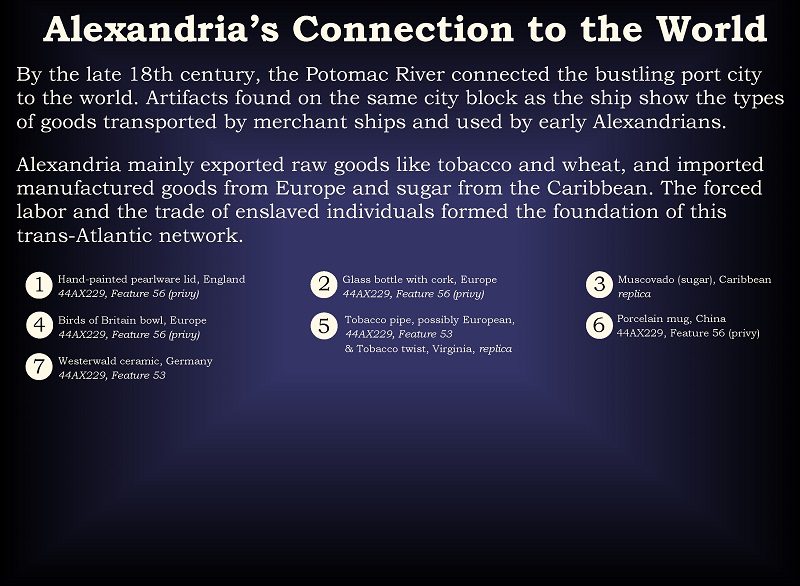
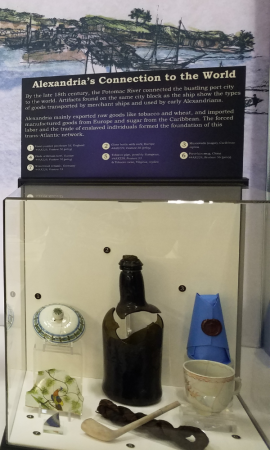
Case panel, Alexandria's Connection to the World


Maritime Exhibit Case 2023
1. Hand-painted pearlware lid, England (44AX229, Feature 56 (privy))
2. Glass bottle with cork, Europe (44AX229, Feature 56 (privy))
3. Muscovado (sugar), Caribbean (replica)
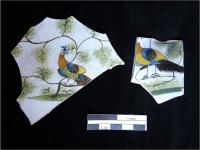
4. Birds of Britain bowl, Europe (44AX229, Feature 56 (privy))
5. Tobacco pipe, possibly European (44AX229, Feature 53) & Tobacco twist, Virginia (replica)
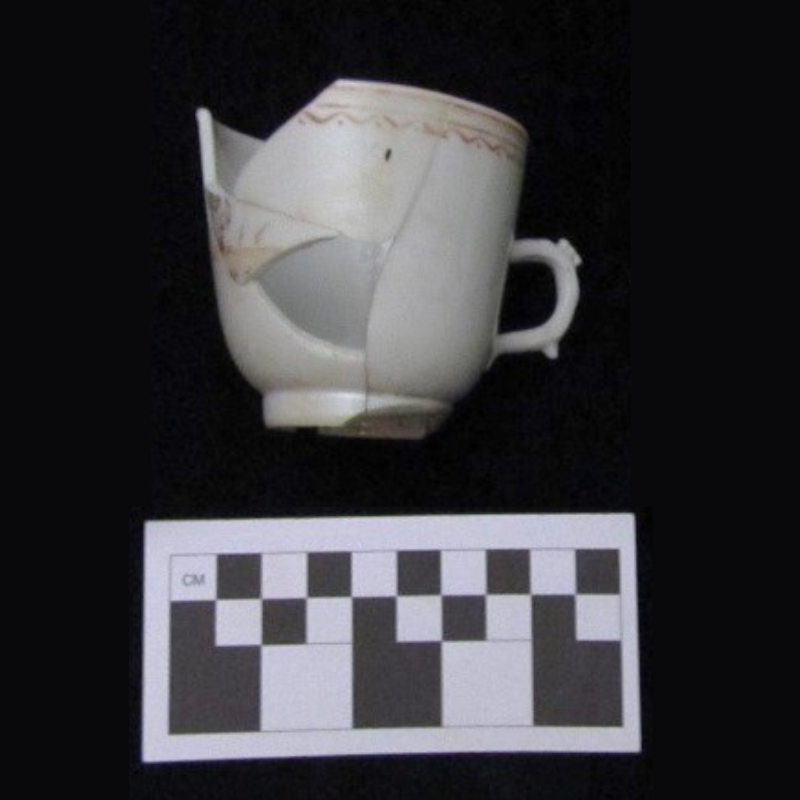
6. Porcelain mug, China (44AX229, Feature 56 (privy))
7. Westerwald ceramic, Germany (44AX229, Feature 53)
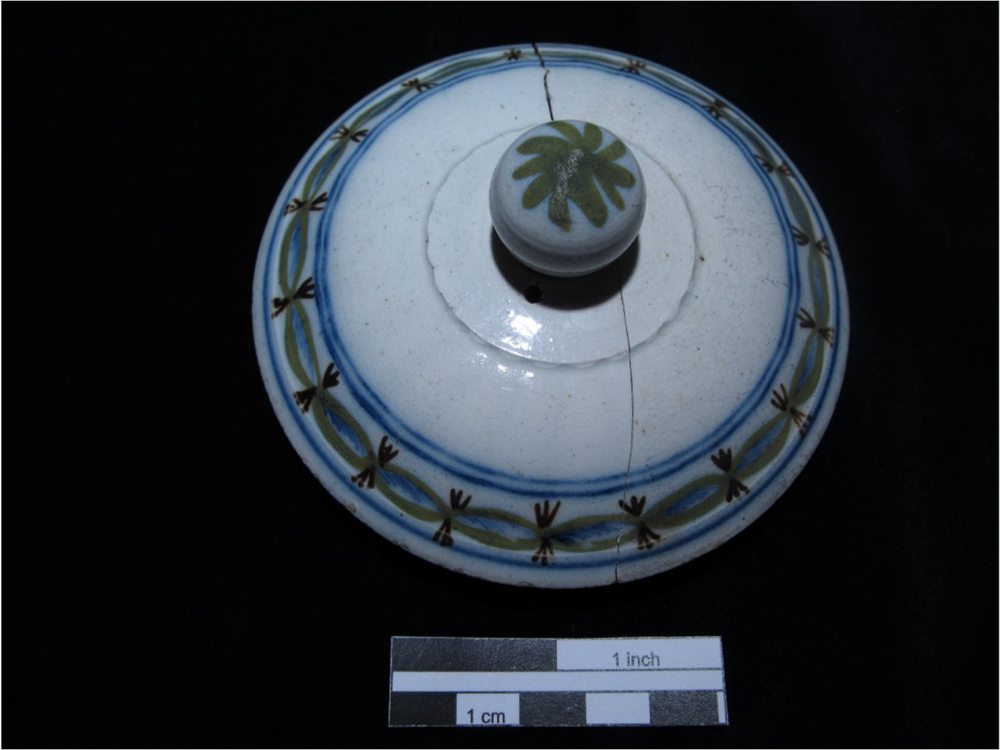
 

Hand-painted pearlware lid with blue and orange design
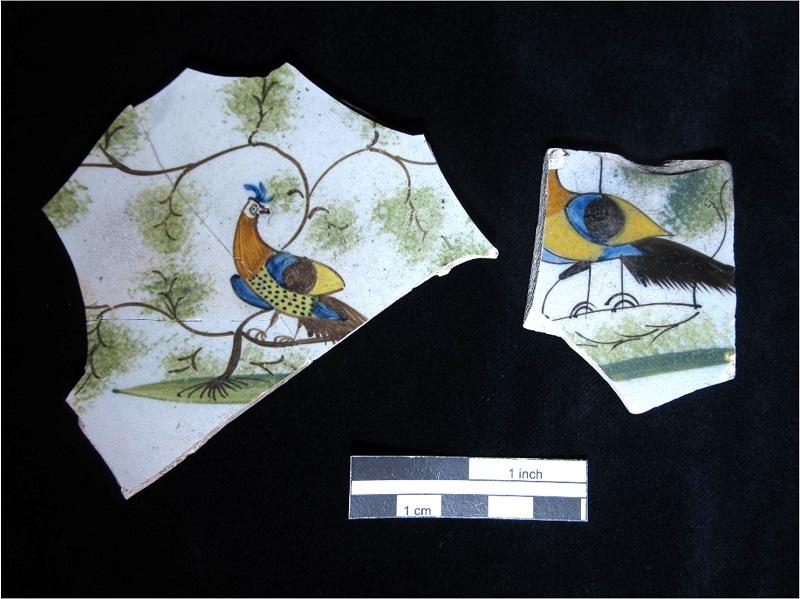
Peahen design on pearlware
Porcelain mug, hand-painted overglaze
of
Grid View Close Modal
Hand-painted pearlware lid with blue and orange design
Hand-painted pearlware lid, England, 44AX229, Feature 56 (privy)
Peahen design on pearlware
Birds of Britain bowl, Europe, 44AX229, Feature 56 (privy)
Porcelain mug, hand-painted overglaze
Porcelain mug, China, 44AX229, Feature 56 (privy)
  • Archaeology
  • Historic Alexandria
  • Museums
Contact Us
Alex311 | 703.746.4311
Follow Us
  • BlueSky
  • Facebook
  • X
  • YouTube
Visitor Information

VisitAlexandriaVA.com

  • Jobs
  • Payments
  • Departments
  • Newsroom
  • Social Media
  • Emergency Hotlines
  • Accessibility
  • FOIA Requests
  • Privacy & Legal

Alexandria City Hall
301 King Street
Alexandria, VA 22314

City of Alexandria Seal
© 1995–2023 City of Alexandria, VA and others.
Hold on, redirecting...