You're logged in with MyAlex  |  Logout

City of Alexandria, VA

Search results cleared

Include archived pages
Most of the content here is written in English. Translate your search to find more content? Translating "" to English... Searching for English phrase ""
  • Live
  • Play
  • Services
  • Business
  • Government
  • Projects & Plans
  • Calendar
  • I want to…

Wayfinding: War of 1812

In August 1814, British ships sailed up the Potomac, and Alexandria’s militias were ordered to cross the river and take up post near Fort Washington. They took with them nearly all the arms belonging to the town, leaving Alexandria defenseless. On the morning of August 28, 1814, a local committee rowed south to meet British Captain James Gordon to request terms of surrender. On Christmas Eve 1814, the Americans and British signed the Treaty of Ghent, formally ending the War of 1812.
Page updated on December 29, 2021 at 1:44 PM

Historic Sites

  • Historic Alexandria (Home)
  • About Historic Alexandria
  • City Museums
    • Alexandria Archaeology Museum
    • Alexandria Black History Museum
    • Alexandria History Museum at The Lyceum
    • Fort Ward Museum & Historic Site
    • Freedom House Museum
    • Friendship Firehouse Museum
    • Gadsby's Tavern Museum
    • Stabler-Leadbeater Apothecary Museum
  • City Historic Sites
    • Alexandria African American Heritage Park
    • Alexandria Union Station
    • Contrabands and Freedmen Cemetery Memorial
    • Lloyd House
    • Murray-Dick-Fawcett House
    • The Fort: A Post-Civil War African American Community
  • African American History Division
  • Alexandria Oral History Center
  • Archives and Records Center
  • Commissions Supporting Historic Alexandria
  • More Historic Sites
    • African American Heritage Trail
    • Del Ray and the Town of Potomac
    • Historic Cemeteries
    • Union Hospitals during the Civil War
    • Wayfinding: Historic Signs
  • News Releases
  • Stay Connected
  • Support Historic Alexandria
    • Make a Gift
    • Become a Member
    • Join a Commission
    • Volunteer

Share

Bluesky Share on Facebook Share on X Share via Email
Translate icon
Translate icon
XWARNING: You have chosen to translate this page using an automated translation system. This translation has not been reviewed by the City of Alexandria and may contain errors.

War of 1812

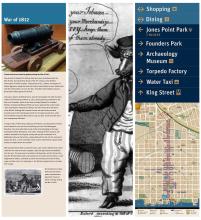
Wayfinding sign, War of 1812

Few periods of Alexandria’s history have been more tumultuous than the War of 1812. During the first decade of the 19th century, Great Britain’s interception of American ships, impressment of U.S. seamen, and support of Indian aggression along the American frontier exacerbated its poor relationship with the United States. On June 18, 1812, President James Madison issued a Declaration of War against the British.

Fearing occupation by British forces, several townspeople met with Secretary of War John Armstrong on March 21, 1812, about preparing a defense for the District of Columbia, which at that time included Alexandria. President Madison and General William Winder were also apprised that unless funds were expended for Alexandria’s defense, the town would be at the mercy of the British. Although the Common Council and area banks provided secured loans to the Federal government for the region’s protection, when General Winder inspected Alexandria on July 25, 1814, he declared the town was inadequately defended.

In August 1814, British ships sailed up the Potomac, and Alexandria’s militias were ordered to cross the river and take up post near Fort Washington, Maryland. They took with them nearly all the arms belonging to the town, leaving Alexandria defenseless. Soon after, realizing the dire situation, the militias retreated to the Virginia countryside and the commander of Ft. Washington blew up the fortress, sealing Alexandria’s fate. On the morning of August 28, 1814, a local committee rowed south to meet British Captain James Gordon to request terms of surrender.

After positioning his fleet to attack the town, Capt. Gordon offered terms which called for the removal of naval supplies, ships and agricultural commodities from the port. The town council acceded to the demands, and for the next five days the British looted stores and warehouses of 16,000 barrels of flour, 1,000 hogsheads of tobacco, 150 bales of cotton and some $5,000 worth of wine, sugar and other items. On September 2, the British weighed anchor and made their escape.

On Christmas Eve 1814, American and British peace commissioners signed the Treaty of Ghent, formally ending the War of 1812.

Read the sign.

Where to find this sign

In Old Town, mini kiosks are located at designated intersections along King Street, Cameron Street, and the Waterfront to provide an orientation for pedestrians. 

This wayfinding sign is located on King at S. Union Street. (For those taking the King Street Trolley, please check the schedule as times may have changed.)

See all the wayfinding signs on and around King Street.


  • Historic Alexandria
  • Historic Sites
Contact Us
Alex311 | 703.746.4311
Follow Us
  • BlueSky
  • Facebook
  • X
  • YouTube
Visitor Information

VisitAlexandriaVA.com

  • Jobs
  • Payments
  • Departments
  • Newsroom
  • Social Media
  • Emergency Hotlines
  • Accessibility
  • FOIA Requests
  • Privacy & Legal

Alexandria City Hall
301 King Street
Alexandria, VA 22314

City of Alexandria Seal
© 1995–2023 City of Alexandria, VA and others.
Hold on, redirecting...