
Women in Business: We Were Always Here
Through this exhibit, meet Hannah Griffith, who operated a coffeehouse in this building. Born a British colonist, Griffith later supported the American Revolution. Widowed not long after the war, she re-invented herself as an Alexandria businesswoman.
Female tavern keepers were common, and Griffith’s story reminds us that the idea of female entrepreneurs is not a new one. Her story also highlights how the American Revolution continued to shape lives in personal and sometimes surprising ways even years later.
What is a Coffeehouse?
Coffeehouses offered the most prestigious customers a place to conduct business while enjoying stimulating beverages.
Coffeehouses specialized in expensive imported beverages like coffee and chocolate that were believed to stimulate intelligent conversation. To succeed in attracting the wealthy clientele, coffeehouse operators had to be associated with the highest levels of “gentility.”
Coffeehouses offered a higher level of service and more privacy than taverns. Many operated on a subscription basis and typically offered space for private meetings. Coffeehouses also offered a large selection of local and national newspapers so members could keep up with current events.
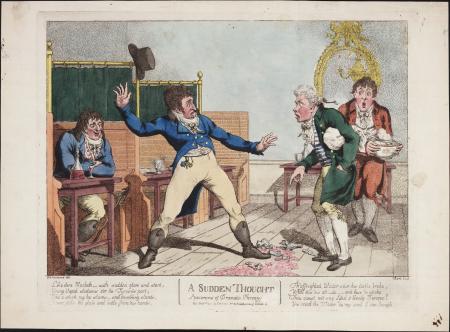
This drawing includes curtained booths often found in coffeehouses. While Griffith likely could not afford booths, Gadsby certainly added them when he took over the business.
A Sudden Thought by Charles Williams, 1804. Courtesy of Lewis Walpole Library, Yale University.
Hannah Griffith
Women like Griffith managed and owned taverns and coffeehouses even though they were male-dominated spaces.
Historians estimate up to two-thirds of taverns in Virginia were owned or managed by white, middling women. As a white, educated woman with connections and some money, Griffith had more options to support her family after her husband died than other working women.
She operated a coffeehouse here from 1794 to at least 1797. She then moved to a house on nearby King Street, where she advertised a boardinghouse which could “accommodate six or eight gentlemen with board.” She supplemented her income by renting land the family owned.
Surviving records only provide glimpses into how Griffith ran the coffeehouse. Records suggest she used a mix of enslaved and hired labor. With seven children still at home, she may also have had older ones assisting with the business, as many families did.
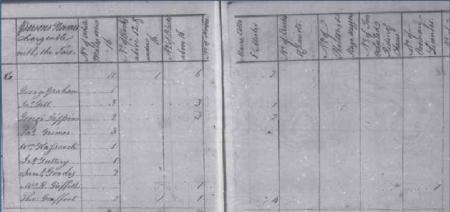
This except from the Alexandria City Personal Property Records from 1795 lists Hannah Griffith as having one enslaved person over the age of 16 and a tavern license.
Why do we see less evidence of women in the historic record?
Women were operating businesses more often than the historic record might reveal due to the English common law doctrine of coverture, which legally tucked the identity of women under their husband or father.
When married, a woman was considered a feme covert, or woman who was legally “covered” by her husband. They could not independently own property, sign contracts, or file a lawsuit, among other things.
Once widowed, a woman’s status changed to feme sole. This allowed single women to conduct their own legal and financial affairs, which included owning and licensing businesses.
Consider these examples of personal, legal, and public records.
- Hannah and David Griffith wrote letters to each other while David served in the Continental Army. Only David’s letters to Hannah survive, but they provide a glimpse into Hannah’s life during the war. Read the transcription.
- In 1785, inheritance laws changed, so everything no longer went to the eldest son. Instead, two-thirds would be divided amongst the children and one-third left to the widow. Hannah filed this petition to argue, contrary to inheritance law, that David wanted his western lands sold to pay off family debt, not divided as part of the inheritance. Read the transcription of Hannah Griffith's petition.
A newspaper advertisement placed in 1787 demonstrates how a woman could be running a business but would not appear in a newspaper until after her husband passed away. Rachel Lomax continued running a tavern on Princess Street between Lee and Fairfax Streets after she was widowed.
The advertisement says: "Mrs. Lomax informs the public and her customers in general, that she intends to continue keeping a PUBLIC HOUSE, equally furnished as in her husband's life-time, and hopes to merit a continuance of their favor, and engages nothing shall be wanting on her part to deserve their custom. Alexandria, Feb. 15, 1787."
Before the Revolution
Hannah’s experiences before the Revolution prepared her for her future operating a coffeehouse. Born between 1745 and 1751, Hannah grew up watching her mother manage a shop. As part of the privileged white class, Hannah also learned to both read and write.
In 1766, Hannah married fellow New Yorker David Griffith. David was a medical doctor and became an ordained minister of the Church of England. Her status as a minister’s wife opened new doors to social opportunities. In 1770, Hannah became a mother with the birth of David Griffith, Jr., the first of eight children.
In 1772, her husband was offered the position of rector for a Loudoun County parish in Virginia. After moving, David began spending much of his time supporting the movement for independence. In February 1776, David enlisted with a dual commission as both a surgeon and chaplain of the Third Virginia Regiment. Hannah and David, the New York outsiders, were now officially Virginia patriots.
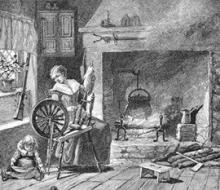
Home and work were rarely separated like they are today. In addition to domestic tasks, women were able to produce goods and run stores from where they lived. Laboring class women could also work as seamstresses or laundresses and take in boarders.
Illustration from A Brief History of the United States by Joel Dorman Steele and Esther Baker Steele, 1885.
During the Revolution
Hannah served as a “deputy husband” during the American Revolution. Hannah continued her domestic duties while also handling her husband’s, which included budgeting, settling debts, bargaining prices for the purchase of items, and managing the farm. Women, including Hannah, also supported the war effort by boycotting British goods and producing clothing at home.
Historian Laurel Thatcher Ulrich created the phrase “deputy husband” to describe a married woman like Hannah who stepped into traditionally male roles while their spouse was at war.
Though the Revolution raged on, David’s military service ended in 1778. By the end of that year, the Griffiths had accepted an offer to the Fairfax parish, which included both Falls Church and Alexandria Church (now Christ Church). They moved into a house on glebe (church-owned) land halfway between the two churches in today’s Arlington County. The parish included well-known members like George Washington, ensuring the Griffiths were well-connected in their new home.
Read excerpts of letters written by Hannah's husband David to her during the Revolutionary War.
After the Revolution
Hannah’s responsibilities expanded after David’s death. In addition to their eight children and the flock of congregants, Hannah provided room and board to young boys of prominent families who were receiving schooling from David.
In 1789, David unexpectedly died while in Philadelphia during the church’s third General Convention. The new Church struggled financially and did not yet have a pension system, so Hannah had to provide for the family. Hannah’s successful pivot from rector’s wife to a respected business owner in a busy port city was in part due to the social capital she accrued as the minister’s wife.
Hannah and her children moved into Alexandria. She directed the sale of David’s western landholdings received as payment for war service to settle debts. To supplement rental income on lots she owned in Alexandria, she operated the coffeehouse and later a boardinghouse.
Hannah's Mortuary Notice was printed in The Alexandria Herald on November 27, 1811. It reads:
Departed this life, on Friday evening last, after a tedious illness, Mrs. Hannah Griffith, relict of the Rev. David Griffith. Let the tear of generous sympathy beam in every eye while deploring the fate of that amiable lady; in her character were blended the mild majesty of private life and all those virtues that make us worthy in our "Maker's eye." The anxious solicitude of her friends, during her indisposition and their regret at her loss, are ample testimony of their sincere attachment and regard. She left an amiable and dutiful family of children whose happiness was her only care, and whom she deeply loved; their grief best testifies their feelings; "None every loved more than they do." Many years since she was deprived of her husband, a man endowed with all those virtues and accomplishments that render men estimable in life, since which the important charge of her family devolved on her alone. -By her fruits may she be judged.-
The Creation of the Episcopal Church
The Revolution created upheaval within the church, bringing an end to the Church of England in America. David was one of the leading clergymen focused on the survival and reorganization of the new Episcopal Church, which replaced the Church of England. While elected first Bishop of Virginia, David could not afford the trip to England for consecration, so he resigned. The Church was still in transition when David passed away.
Women in Business
Women have always been an essential part of Alexandria’s businesses. The idea of female entrepreneurs is not new. While it may not be easy to see in the historic record, women were always operating businesses in Alexandria and beyond.
According to 2022 U.S. Census Bureau data, more than one in five businesses in Alexandria is woman-owned. Today, on the streets directly around City Hall alone, there are 14 women-owned businesses! Meet the women behind the businesses here and scan the QR code on their panel to visit their business online.
Learn more about women's history in Alexandria with Alexandria Celebrates Women.
Thinking of starting a business? The Alexandria Economic Development Partnership can help.
Women-owned businesses around City Hall today include:
Amanda Lasker, Owner of Gossypia
325 Cameron Street
gossypia.com
For over 65 years, Amanda Lasker has been bringing together a collection of global items—from India, Lithuania, Japan, Mexico, and more—for Old Town shoppers. Lasker’s world travels started with her early career as a cotton broker in Sudan, then a Foreign Service Officer in Guatemala, and later with the CIA in Mexico City. Her travels continue today as she personally curates the store’s unique selection.
Charlotte Hall, former Old Town Business Association executive director, describes Lasker as “one of several female pioneers in the retail community in Old Town,” paving the way for today’s boutiques. Located at the corner of Cameron and North Royal since 1970, her colorful and unique shop has become an Old Town landmark.
Caity Davis and Jill Sump, Owners of FitOne
319 Cameron Street
fitonestudio.com
Founded in 1999 by Caity Davis and Jill Sump, FitOne brings over 27 years of expertise to every workout. Whether it’s Caity growing up with three brothers or Jill watching her mom in 1980s aerobics classes, their passion for fitness started young. They enjoy helping clients achieve lifelong, injury-free fitness and sustainable results that truly fit their lifestyle.
FitOne is Alexandria’s most distinctive boutique fitness studio, delivering highly individualized training programs in a positive, welcoming, and results-driven environment. Serving everyone from exercise beginners and expectant moms to active older adults and competitive athletes, FitOne offers a space where clients feel respected, encouraged, and never intimidated.
Elizabeth Todd, Owner of The Shoe Hive/The Hive
315 Cameron Street
theshoehive.com
Elizabeth Todd opened The Shoe Hive in 2003 and immediately made a splash—being named the region’s best shoe store in its first year. Her growing businesses specialize in clothing and shoe lines curated for women. She is known for her eye for fashion and has attracted a loyal clientele seeking elevated basics that are worth the investment.
As her businesses expanded, so did her support of local entrepreneurs. In 2008 she helped to co-found the Old Town Boutique District, a cooperative effort amongst business owners to promote shopping in the area. Then, in 2013 she launched the Alexandria Stylebook to promote Alexandria’s vibrant community from the perspective of local business owners and leaders.
Arielle Weinburg and Katri Haas, Owners of Arielle Shoshana
313 Cameron Street
arielleshoshana.com
In spring 2026, Alexandria welcomed Arielle Shoshana co-owners Arielle Weinberg and Katri Haas. As Old Town's first niche fragrance boutique, shoppers can now experience a perfume playground for audaciously original scents not found anywhere else. The boutique is bursting with hundreds of never-before-smelled fragrances, body products, and home fragrances from all around the world.
Being an invisible product makes perfume inherently inclusive—it can never be the wrong size or the wrong shade. Katri's graphic design background led her from design firms to the beauty industry via visual merchandising. Arielle's biology degree led her to perfumery school rejection letters. Together, they are so proud to be building a space as welcoming and fun as fragrance should be.
Sirin Kalinkara, Owner of Solid Kitchen and Bath
303 Cameron Street, Suite 1
solidkb.com
Sirin Kalinkara has worked in the kitchen and bath industry since 2014. In 2019, she took over Solid Kitchen and Bath. Since then, her studio on Cameron Street has been a place where thoughtful design and everyday living come together. Since opening, she has won the Best Service Award from Houzz every year.
With every project, she strives to ensure a beautiful product and satisfied customer. Rooted in the Alexandria community, her work honors the character and history of its homes while carefully remodeling kitchens and bathrooms for modern life. Deeply passionate about her work, she finds meaning in creating spaces that are both functional and beautiful.
Deborah Buelow, Owner of Cedar Architects
303 Cameron Street, Suite 2
cedararchitecture.com
Deborah Buelow is an architect with over 25 years of experience across New York City, Boston, and D.C. In 2016, she founded Cedar Architecture, an architecture and interior design practice grounded in sustainable, health-focused architecture. They specialize in custom residential design that balances technical performance and environmental responsibility with genuine beauty.
Buelow believes architecture is a powerful lever for change and is driven by the conviction that buildings should actively support both human well-being and ecological health. Whether designing a home or advocating for climate and housing policy (both for the City of Alexandria), her goal is to ensure our built environment acts as a positive force for the people who inhabit it and the planet we share.
Jamie Fortin, Owner of Friends to Lovers
301 Cameron Street
friendstoloversbookstore.com
Jamie Fortin is the founder of Friends to Lovers, the region’s first romance bookstore. Inspired by Alexandria’s vibrant reading culture, Jamie opened Friends to Lovers in November 2024 to create a space where women and queer people can celebrate stories that bring them joy.
When a devastating fire destroyed the store 3 days after opening, the community rallied, raising $46,000 in a matter of days. Local businesses – almost all owned by women – stepped up, offering free shelf space to sell inventory during the holiday season.
Friends to Lovers reopened in April 2025 at 301 Cameron St. Guided by its community-driven mission, the shop provides civic engagement resources and hosts events to uplift local authors and creators.
Meredith Nowlin, Owner of Moxie Hair Studio
201 N. Fairfax Street
moxiealx.com
Meredith Nowlin began her journey as a stylist in 2008 and, after years mastering her craft, founded Moxie Hair Studio in Old Town Alexandria in 2021. What began as a dream of creating a space where clients feel truly heard has blossomed into something richer: a gathering place where small business owners, friends, and family connect through events and shared purpose.
Meredith is a mentor at heart, dedicated to uplifting young stylists and giving them room to grow. She brings warmth, wit, and genuine empathy to everyone she meets. As a mother to her daughter Amelie, she nurtures creativity and kindness with the same devotion she brings to her community. Meredith doesn’t just style hair—she builds belonging.
Carla Clarke, Vice President of Today’s Cargo
117 N. Fairfax Street
todayscargo.com
Carla Clarke can still recall the excitement of opening her first Today’s Cargo box—a pair of ruby studs from her mom. After college, Clarke stopped by the store with her mom Virginia and then co-owner Donna McIntyre said, “Virginia, do you know anyone looking for a job?” The rest is history! Carla is now a Graduate Gemologist with the Gemological Institute of America (GIA) and a Certified Master Appraiser (NAJA).
Becoming co-owner in 2021, Clarke proudly continues the legacy of Today’s Cargo, which began in 1973. With her expertise, Clarke curates the store’s estate and fine jewelry collections and has been integral in taking the custom design services to a new level. She loves seeing the joy on the faces of clients and is proud that Today’s Cargo has been part of the Old Town community for over 50 years.
Mara, Owner of The Antique Guild
113 N. Fairfax Street
theantiqueguild.net
Mara is the woman behind The Antique Guild. The shop, established in 1980, is located in an historic 18th century townhouse across from the City Hall on the 100 block of North Fairfax Street in the heart of Old Town Alexandria. The shop specializes in antique & estate jewelry, fine silver, and an eclectic range of antiques with an emphasis on quality at most reasonable prices.
First exposed to the antique world as a child in Germany, Mara loved to accompany her parents to the antique shops, museums and castles. Those experiences translated into a passion/obsession for the antique business after living two years as a student in Spain and then graduating from The George Washington University in Washington, D.C.
Hattie Dove, Owner of Era
109 N. Fairfax Street
era-edit.com
Hattie Dove is the owner of Era, a women’s boutique. She graduated from the University of Georgia in 2013 with a degree in Fashion Merchandising and has worked in the fashion industry ever since. After moving to Virginia in 2014, she quickly fell in love with the charm and community of Old Town. In June 2024, she turned a longtime dream into reality by opening Era.
Owning her own boutique allows her to focus on the parts of fashion she’s most passionate about—styling women and thoughtfully curating a collection that feels both elevated and wearable. Era offers something for every style and taste, plus friendly, knowledgeable faces always happy to help you find the perfect outfit.
Joy Quinn-Whalen, Owner of The Spice & Tea Exchange
320 King Street
spiceandtea.com
Joy Quinn is a multi-unit owner of The Spice & Tea Exchange, operating locations in Alexandria, Annapolis, and Rehoboth Beach. A mom of three and an alto saxophonist with the Fairfax City Bands, she is a hands-on business owner passionate about growth and people-centered leadership.Her journey began 15 years ago when launching her Alexandria store while living in Old Town.
Joy creates and shares a flavorful life through a true flavor wonderland—one designed to spark curiosity, invite exploration, and deliver a WOW customer experience far beyond typical retail. Equally important to Joy is developing her team by building systems that empower people to grow, lead, and serve with confidence every day.
Rachele Cooper, Owner of Aptive
110 N. Royal Street, Suite 400
aptiveresources.com
Rachele Cooper is a Navy Veteran and the founder and CEO of Aptive Resources, a woman-owned professional services firm that enhances service delivery and improves experiences for millions of people who count on government services every day. Aptive supports federal agencies across health, defense, and Veterans affairs to achieve their missions.
The work is driven by a deep belief in public service and the power of teams to solve complex problems. With experience spanning military service, engineering, and federal consulting, Rachele is passionate about building solutions that make a measurable difference in people’s lives and about creating a company where purpose, resilience and service remain at the center of growth and success.
Beth Lawton and Lore Burek, Owners of Made in ALX
415 King Street
madeinalx.com
Beth and Lore met through ALX Community in 2017 and launched Made in ALX in 2020 as a local online marketplace where residents could find handcrafted and locally-made items. Its mission is to connect the community with local creators. Over the years, Made in ALX has developed as both an unbeatable "shop local" marketplace and a meeting point for people who love Alexandria and art.
The business now supports more than 60 local residents creating everything from gorgeous paintings to unique ceramics, jewelry, candles, home décor, and even local honey and books. In addition, Made in ALX offers a variety of beginner-level classes in a variety of disciplines and offers free crafts for children every month.