
Buildings as Collections
Historic buildings provide a sense of place and space. They are the largest objects in Historic Alexandria’s collection and require constant care to ensure they can be visited for generations to come. The following are two recently completed preservation projects.
Freedom House Museum
1315 Duke Street is all that remains of a large complex that was once devoted to trafficking thousands of Black men, women, and children between 1828-1861. The multi-year exterior rehabilitation was completed in the Fall of 2025. Masons, woodworkers, and other craftsmen stabilized this important building and returned it to its pre-Civil War appearance, which helps tell the story of the domestic slave trade.
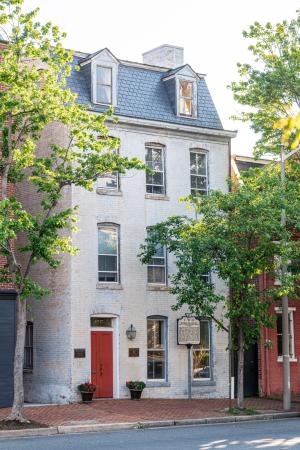
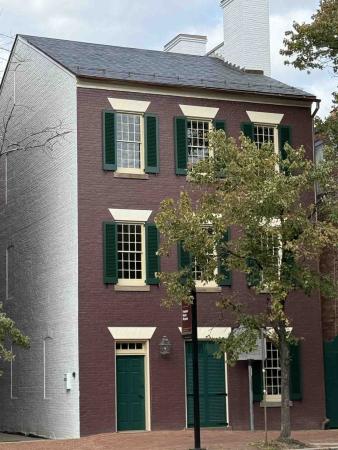
The façade work at Freedom House required changing masonry openings to install new windows and shutters, a new roofline, recreating the location of the retail door in the middle, and using historic paint color schemes.
On display
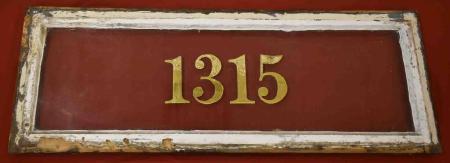
Transom, ca. late 19th-early 20th century
This transom from Freedom House Museum at 1315 Duke Street was placed over the front door as part of its conversion into apartments at the turn of the 20th century. It was removed during the recent exterior rehabilitation project as it post-dates the interpretive period of 1812-1861. Architectural pieces such as this are kept in the Museum’s collection as they are important for documenting and understanding the building’s history.
Murray-Dick-Fawcett House
Located at 517 Prince Street, this building is one of the oldest homes in Alexandria. This 18th- century house underwent a two-phase restoration starting in 2021. Research informed a historically accurate replacement of the roof during Phase I, including new fish-scale wood shingles based on the original. Phase II restored the exterior, focusing on doors, windows, wide-board siding, the porch, and the primary entryway.
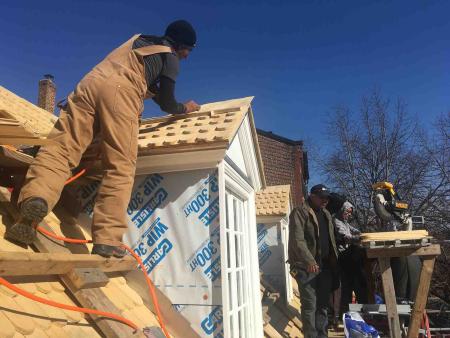
Preservation work was conducted after careful examination of archival materials, research based on Historic American Buildings Surveys and Historic Structure Reports, and field investigation such as dendrochronology and laboratory paint analysis.