
Collecting Stories
Oral histories deepen our understanding of the past by capturing personal perspectives and memories. Historic Alexandria collects these through The Alexandria Oral History Center and uses a community-driven approach to document and preserve the stories of Alexandria. The following are three recent oral history initiatives.
Colored Rosemont
Bounded by Pendleton, Fayette, Madison, and N. West Streets, the community once known as “Colored Rosemont” was established in 1926 when real estate broker Virginia F. Thomas sold plots to African American families. Residents informally called the community “Colored Rosemont,” a reminder that Alexandria was racially segregated. Restrictive covenants prevented African Americans from owning or renting in other neighborhoods, including the nearby Rosemont neighborhood. The Colored Rosemont Community History Initiative is a collaboration between the Office of Historic Alexandria and former and current residents of Colored Rosemont (2022-present).
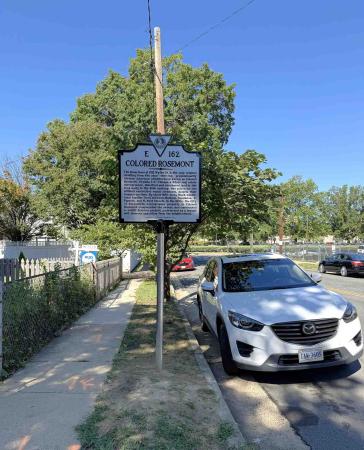
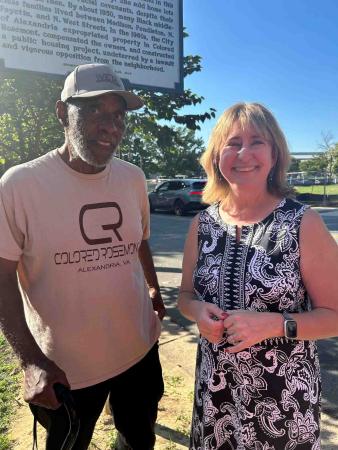
A state historic marker for Colored Rosemont was dedicated September 13, 2025. Community member Stanley Greene and Office of Historic Alexandria Director Gretchen Bulova participated in the ceremony.
Historic marker text:
E 162
Colored Rosemont
The house here at 1312 Wythe St. is the only original dwelling from the once-thriving, predominantly African American neighborhood known as Colored Rosemont. Virginia F.W. Thomas a White real estate entrepreneur, inherited and purchased land in this area early in the 20th century. She sold home lots without restrictive racial covenants, despite their common use then. By about 1950, many Black middle-class families lived between Madison, Pendleton, N. Fayette, and N. West Streets. In the 1960s, the City of Alexandria expropriated property in Colored Rosemont, compensated the owners, and constructed a public housing project, undeterred by a lawsuit and vigorous opposition from the neighborhood.
“I remember the glider on the Waterson’s porch and their regal Great Dane named Fox... And the latest music emanating from the Carter's backyard…So many, many memories.”
Excerpt from Veronica Greene-Pace’s oral history (2024).
“I was just sitting down in the middle of the tomato patch and eat the little
cherry tomatoes. They had to stop me, because I'd get home and the corners of my mouth would be stinging and burning from all the acid from the tomatoes.”Excerpt from Maria Edwards’ oral history (2024).
“In general, looking back, I think it was sort of an idyllic existence for blacks during segregation. We were aware of segregation and my parents, I think, tried to shield us from it as best they could, but we had a pretty much happy existence. Sort of contained in our own particular neighborhood.”
Excerpt from John Greene’s oral history (2024).
Douglass Cemetery
The Frederick Douglass Memorial Cemetery was established in 1895 as a segregated, nondenominational African American cemetery. The last known burial at Douglass was in 1975. The Douglass Cemetery Community History Initiative began in 2022 to preserve and interpret the history of the cemetery.
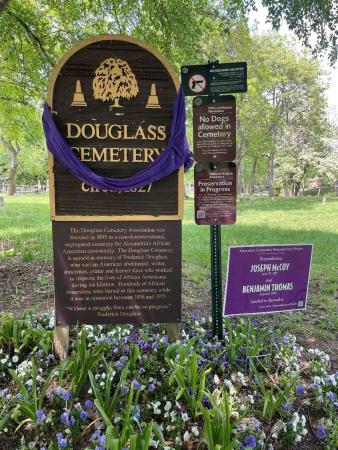
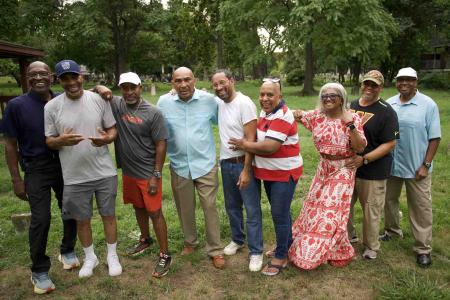
“And now, reconnecting with ancestors that I didn't know…It's fitting. It's beginning to fit. I no longer have to wonder who they are, where they are. Because history tells me.”
Excerpt from Stephanie Johnson’s oral history (2024).
“…I realized that it [Douglass Cemetery] first came to my attention because the one headstone, my grandfather was there on my father's side…since then, I realized that there are six other members at Douglass with the last name….It does good for me to know how long my family has history in Alexandria…how many people can tell you that their family has been representing Alexandria for 150 years?...”
Excerpt from Myron Contee’s oral history (2024).
“…it's history in that cemetery. And if one took the time like me, myself, take the time and start doing research, you'll find it's some real important people in there...”
Excerpt from Steve Johnson’s oral history (2024).
Seminary
The Seminary area is a historic African American neighborhood, located around the Virginia Theological Seminary and Fort Ward. Several oral histories have been recorded about neighborhood life in the 20th century and the displacement of the community in the 1960s.
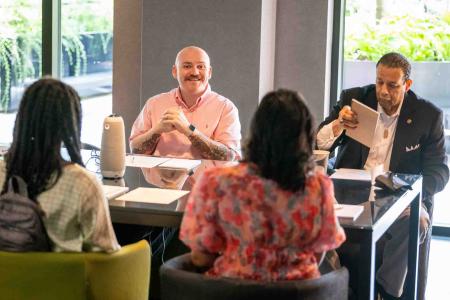
“…the city decided…it needed a new site for a new high school…so they [the city] started eminent domain procedures...But, during the process, the community organized…But there was a negotiated compromise…at least 23 families who had land rights in that area were able to stay and make up what is…1010 Woods Place and Woods Avenue. And the way we got in was…some great negotiation on the part of my grandmother, Ada…provided the opportunity for both my aunt and my mother to have one of the new homes.”
Excerpt from Judy Belk’s oral history (2024).
“I call Seminary my family…In 1957, all of us were in one house, my aunts and all of us…I realized something about where I lived at in Seminary…I ain't never had a house key! [laughs] Nobody's door locked in the Seminary [laughs]…And when I moved to my aunt in the projects, the first thing she did was give me some keys.”
Excerpt from Clyde Casey, from his and Jim Lewis’s StoryCircle (2024).